![Industrial Ground Repair Strategies for Australian Warehouses [in 2025]](https://civilcraft.com.au/wp-content/uploads/2025/07/Industrial-Ground-Repair-Strategies-for-Australian-Warehouses.jpg)
If you’ve ever walked across a warehouse floor and noticed uneven surfaces, cracks, or even minor dips, you’re looking at issues that go far beyond cosmetic problems. These are warning signs that your warehouse floor might be due for repair.
And in the industrial world, a damaged floor doesn’t just mean inconvenience; it can mean downtime, safety risks, and thousands of dollars lost. Let’s break down what warehouse floor repair really involves, why it matters, and how to approach it smartly if you’re managing or maintaining an industrial site anywhere in Australia.
Why Warehouse Floor Repair Deserves Serious Attention
Here’s the thing: the floor of your warehouse isn’t just the ground people walk on. It’s the foundation of your entire operation. Forklifts move across it all day, pallets are dragged, heavy loads are dropped, and water or oil spills often go unnoticed for hours.
Now imagine all of that on a cracked or sinking surface. Equipment gets damaged. Workers trip or strain themselves. And inspections? Forget it—you’ll get flagged quickly. This is why warehouse floor repair strategies need to be planned, not patched.
Common Warehouse Floor Issues in Australia
Australia’s industrial sector faces a mix of environmental and operational pressures. We’re talking fluctuating temperatures, heavy machinery, moisture exposure, and time. Some common floor issues across warehouses here include:
- Cracks from concrete fatigue
- Joint failures where slabs meet
- Settlement or sinking in certain areas
- Spalling (where the surface breaks away)
- Dusting, a constant problem in older buildings
These aren’t rare. These are the realities of busy industrial sites that have been operating for years without major floor maintenance. And it can sneak up on you if not monitored.
Choosing the Right Repair Strategy
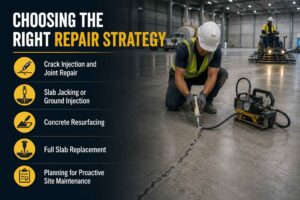
So, what are your options? Here’s how experienced civil contractors, like the team at Civilcraft, typically approach warehouse floor repair.
-
Crack Injection and Joint Repair
Not all cracks are the same. Some are on the surface, while others dig deep. Structural cracks may need epoxy injection to fill the gaps and restore strength. Polyurea fillers are often used for joints because they set quickly and are flexible, making them perfect for high traffic areas.
-
Slab Jacking or Ground Injection
If your floors have sunk or become uneven, slab jacking (sometimes called pressure grouting) is the best way to fix them. It means putting grout under the slab to raise it back up. It’s less invasive and takes a lot less time.
-
Concrete Resurfacing
If the top layer is worn out but the structure underlying is still strong, you can give it new life by resurfacing it with industrial-grade coatings or overlays. This is like giving your floor a professional facelift with Civilcraft expertise.
-
Full Slab Replacement
In terrible circumstances, as when there is inadequate drainage, corrosion, or base failure, you might have to replace parts of the slab completely. It takes more work, but it’s occasionally required to ensure safety and compliance.
-
Planning for Proactive Site Maintenance
This is where Civilcraft’s approach to industrial site maintenance really shines. We don’t wait for visible damage; instead, we engage with facilities managers to set up regular floor checks, moisture tests, and preventative treatment. It’s better for your budget in the long run, and it helps you prevent those “oh no” moments during work.
What Civilcraft Does Best
Civilcraft has found a niche in doing big warehouse floor repair works on commercial and industrial sites all around Sydney. We are experts because we know both the technical side of things and the real-world problems that come up when working with live operations.
We don’t just rip out and replace concrete. We plan around your schedule. We distribute work to avoid operational disruption. And we actually communicate (a rarity in the world of heavy machinery and hi-vis jackets).
If you’re dealing with an older site or a warehouse that sees daily forklift traffic, our approach combines modern materials with good old-fashioned problem-solving. You can book an appointment, and we will be happy to help.
Key Considerations Before You Start Repairs
Before jumping into any repairs, you’ll want to do a proper assessment. Here are a few smart things to check:
- Material compatibility: The repair material needs to bond well with your existing slab.
- Downtime allowance: Can you spare a few days without access to certain zones?
- Compliance: Your fix must meet Australian building and workplace safety codes.
- Drainage conditions: Are water leaks or poor runoff contributing to damage?
- Load requirements: Will the repaired floor handle your equipment weight?
Pro tip: Always ask for before-and-after references from your contractor. You’ll know you’re in good hands when they can show you jobs they’ve completed in similar warehouse environments.
Don’t Let Small Problems Become Big Ones
Here’s what often happens. A minor crack gets ignored. It expands. Moisture seeps in. The base gets weak. Then someone trips, a forklift gets stuck, or worse, a slab section collapses. All that because someone thought it wasn’t a priority.
Warehouse floor repair isn’t just about fixing something that’s broken. It’s about keeping operations running smoothly, avoiding injuries, and protecting your investment.
Also Read:- Why Regular Landscaping Maintenance Matters for Australian Properties
Conclusion
If you’re managing an industrial warehouse in Australia, floor repair might not seem glamorous, but it’s mission-critical. Whether it’s a small crack or major wear and tear, the right strategy can save you a ton in downtime and future repairs.
Partnering with experienced contractors, like Civilcraft, who understand the details of warehouse floor repair, can make the whole process smoother. Don’t wait for the forklift to bounce over another crack. Sort it now and keep your operation solid from the ground up.
FAQs
Q:- How often should warehouse floors be inspected in Australia?
Ans:- Ideally, once every 6–12 months. High-traffic areas may need quarterly checks. Regular inspections are part of smart site maintenance.
Q:- What causes concrete slabs to sink in warehouses?
Ans:- Poor compaction during the initial pour, water erosion, or long-term pressure from heavy equipment can all lead to slab settlement.
Q:- Can you repair damaged floors without shutting down the entire warehouse?
Ans:- Yes. With careful planning, contractors like Civilcraft can section off areas and carry out repairs without halting operations.
Q:- Are epoxy coatings worth the cost for resurfacing?
Ans:- If your slab is structurally sound, epoxy or polyurethane coatings can extend floor life by 5–10 years and improve safety with slip-resistant finishes.
Q:- What’s the average cost of warehouse floor repair in Australia?
Ans:- Depends on the issue. Crack filling can be a few hundred dollars, while full slab replacement runs into thousands. Having a contractor do a site visit is the best way to get an accurate quote.