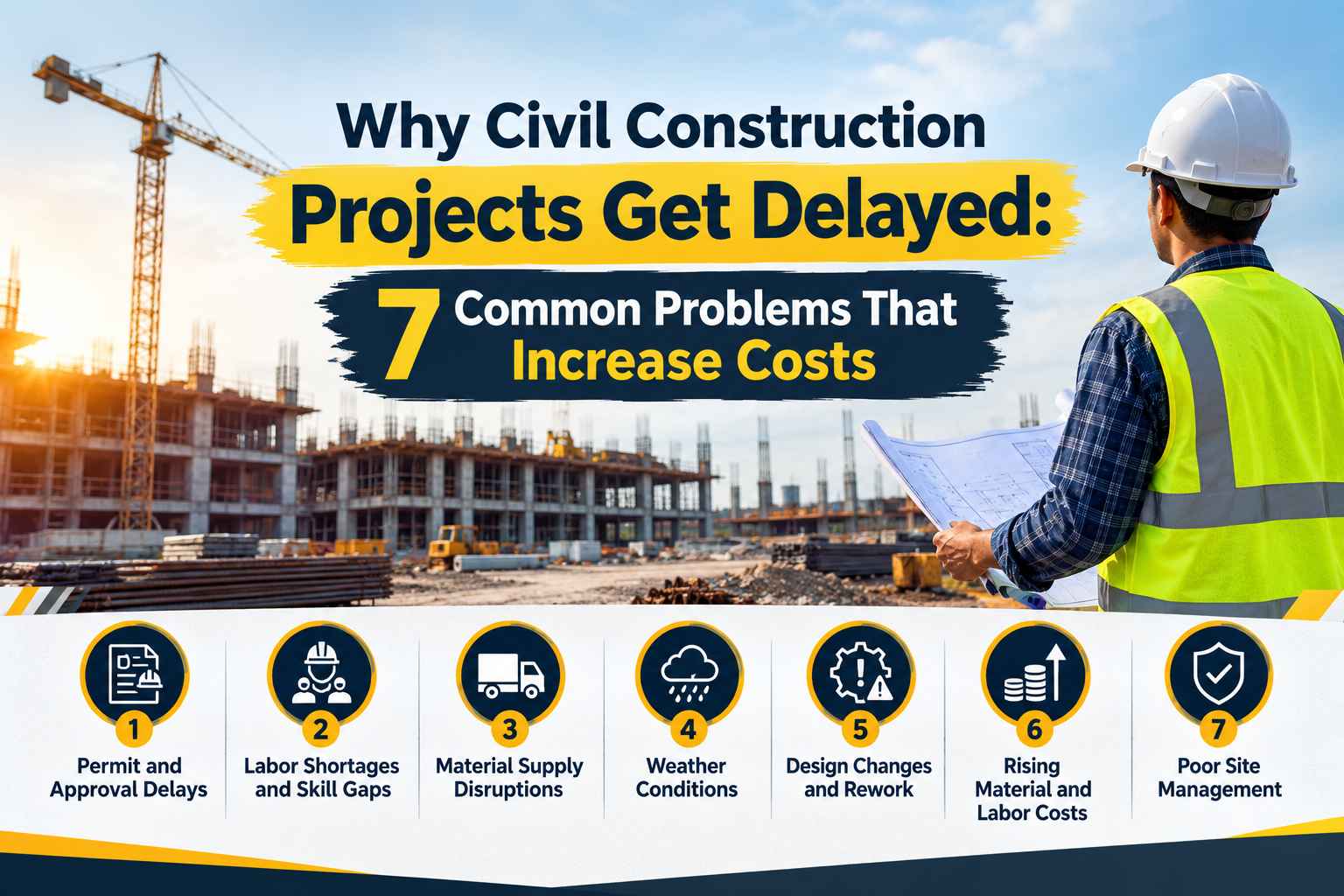
A civil project can be running smoothly on Monday and lose a week by Friday.
It might start with an unexpected service, a design clarification or a delayed material delivery. None sounds catastrophic. The trouble comes when that issue affects the next activity, then the next one, until crews, equipment and subcontractors are waiting around.
That is when a manageable problem becomes a cost problem.
Infrastructure Australia’s 2026 Annual Performance Statement found that expected project duration increased for 17 of 72 assessed projects. Of those, 13 were forecasting construction schedule increases of at least 25%. At the same time, 48 projects had completion dates that were unchanged or brought forward.
So what separates a resilient civil construction programme from one that keeps slipping?
Usually, it comes down to how early the risks are identified.
1. Site conditions were underestimated
- The ground does not always cooperate with the drawings.
- Rock, groundwater, unsuitable fill, contamination or unstable ground can change excavation methods, quantities and sequencing. That may lead to additional investigation, disposal requirements, treatment or design changes.
- Good pre-construction investigation cannot eliminate every surprise, but it can reduce the number of expensive ones.
- For developers and asset managers, this matters because an unknown site condition can affect both construction cost and programme certainty.
2. Underground services cause an unexpected stop
- This is one of the risks that can bring excavation to a sudden halt.
- Electricity, gas, water, sewer and telecommunications services may cross a work area or sit close to proposed excavation. Damage can create safety risks, service outages, repairs and significant delays.
- Safe Work Australia requires current underground essential services information to be obtained before excavation and specifically points PCBUs towards Before You Dig Australia for service information.
- But service plans are not a substitute for proper site controls. Where the risk warrants it, service locations may need further verification before excavation proceeds.
- A few hours spent confirming a service can be far cheaper than dealing with a damaged one.
3. The scope changes after work begins
- A revised drainage layout. A changed finished level. An additional access requirement.
- These changes may sound minor in isolation, but they can affect quantities, labour, plant and sequencing once construction is underway.
- Changes cannot always be avoided. Poorly controlled changes can.
- A clear scope, coordinated drawings and a defined variation process help the project team understand the effect on cost and completion dates before the change becomes site rework.
4. Approvals are not ready when the contractor is
- Having crews and equipment available does not help if the work cannot legally or practically proceed.
- Planning, environmental, utility and authority requirements can all affect mobilisation and construction sequencing.
- This is why approval tracking should form part of programme planning, with clear responsibility for each submission, review and decision.
- The question is not simply, “Have we applied?”
- It is, “What must be approved before this activity can start?”
5. Labour and materials become bottlenecks
- The Australian infrastructure market continues to face capacity pressures.
- Infrastructure Australia’s 2025 Market Capacity Report found that industry organisations identified material costs as a major or significant disruption at 64%, labour costs at 63%, and labour and skills shortages at 59%. The report also forecasts a potential infrastructure workforce shortage of up to 300,000 workers by 2027.
- That makes resource planning more than a procurement exercise.
- If a project depends on specialist trades, particular materials or limited plant, those requirements need to be identified early and tracked throughout delivery.
6. Weather disrupts the sequence
- Some construction activities simply do not respond well to wet conditions.
- Heavy rain can affect excavation, access, earthworks and compaction. It can also change how safely plant and people can operate on site.
- A realistic programme should allow for foreseeable weather impacts rather than assuming every working day will produce the same output.
- That is especially important when several activities depend on one another.
7. Poor coordination creates rework
- Rework is painful because the project has already paid for the work once.
- A crew uses an outdated drawing. A design revision does not reach the right subcontractor. An inspection is missed. Work then has to be altered, removed or completed again.
- The cost includes more than materials. There is labour, plant time, supervision and lost production.
- Clear communication, controlled documentation, inspections and timely decisions help prevent these problems from reaching the construction stage.
How Can Civil Contractors Reduce Construction Delays?
The strongest approach is to identify constraints before they reach the work face.
A Useful Pre-start Review Should Cover:
- Site, survey and geotechnical information
- Underground services
- Design interfaces and outstanding information
- Approvals and authority requirements
- Critical materials and specialist resources
- Site access and traffic controls
- Weather allowances
- Inspection and testing requirements
- Variation and communication procedures
Safety planning matters too. Safe Work Australia identifies excavation in or near a trench deeper than 1.5 metres as high risk construction work, among other specified activities, requiring a SWMS before the work begins.
What Should You Check Before Hiring Civil Contractors?
Do not make the decision on tender price alone.
Ask whether the contractor has delivered comparable work in similar operating environments. Check their approach to safety, quality, programme management, subcontractors, underground services and unexpected site conditions.
Then ask a simple question:
“What do you think could delay this project?”
A strong answer should be specific to your site, not a list of generic construction risks.
Civilcraft‘s project work includes airports, defence, ports, industrial facilities and roadworks, including projects where construction has to be coordinated around active operations. Its stated capability covers engineering, project management, construction, maintenance and risk assessment.
That type of experience matters when the cost of disruption extends beyond the construction site itself.
Also Read:- Why Do Line Markings Fade So Quickly? Common Causes and When to Re-Mark Your Site
Keep Small Problems From Becoming Large Costs
No civil contractor can promise that every project will run without surprises.
The better question is whether the project team has the experience and systems to identify risks early, respond quickly and keep one problem from triggering five more.
For developers, asset managers, government agencies and facility managers, the right Civil Contractors should bring more than machinery and labour. They should bring sound planning, engineering judgement, safety discipline and clear communication.
That is what protects the programme.
And ultimately, it protects the asset and the budget behind it.
FAQs
Q:- What causes delays in civil construction projects?
Ans:- Common causes include unexpected ground conditions, underground service conflicts, scope changes, approval delays, labour or material shortages, weather and rework.
Q:- How can civil contractors reduce construction delays?
Ans:- They can investigate site conditions early, verify underground services, coordinate designs, plan procurement, track approvals and use realistic programmes with appropriate risk controls.
Q:- Who is responsible for unexpected site conditions?
Ans:- Responsibility depends on the contract, project information and agreed allocation of risk. Tender and contract documents should clearly state how unforeseen conditions and variations will be assessed.
Q:- How do civil contractors manage underground service risks?
Ans:- They obtain current underground service information, assess the excavation area, verify locations where necessary and implement appropriate controls before excavation. Safe Work Australia requires current essential services information to be obtained before excavation.
Q:- What should I check before hiring a civil contractor?
Ans:- Check relevant project experience, safety systems, resources, quality processes, programme controls, references and the contractor’s approach to site-specific risks and unexpected conditions.