Alarms, sprinklers, and fire escapes may be the first items that spring to mind when considering building fire safety. Concrete is a silent hero frequently disregarded. In addition to being strong and long-lasting, this multipurpose building material is also effective at preventing fires.
Knowing fire rating for concrete can help you understand how important it is to keep people and property safe, especially if you live in Australia, where bushfires and urban fire hazards are too real.
This post will explain what fire rating is, how it’s determined, and why concrete performs exceptionally well regarding fire safety. We’ll also discuss the critical role that concrete repair plays in upholding these standards over time.
What Is Meant by “Fire Rating for Concrete”?
A fire rating indicates how well a building material, such as concrete, can tolerate heat and fire over a given time frame. Time (in hours) is used to express it. For instance, a wall with a “2-hour fire rating” can withstand fire exposure for at least two hours without losing its structural integrity.
The National Construction Code and AS 3600, the Australian Standard for concrete structures, serve as the guidelines for these standards in Australia. These codes specify the concrete’s thickness and the reinforcement needed.
It also includes other specifics to ensure the building survives a fire long enough for people to flee and firefighters to perform their duties. Concrete is frequently used in tunnels, apartment complexes, commercial buildings, and even bushfire-resistant homes because of its fire rating.
Why Concrete Is Naturally Fire-Resistant
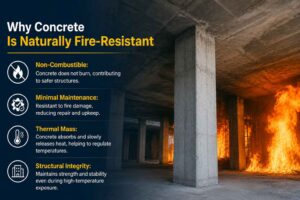
Concrete doesn’t burn or ignite like steel or wood does. Additionally, it doesn’t emit any harmful fumes. It is the perfect fire barrier because of its density, low heat conductivity, and non-flammable nature. Concrete buys time by slowing the spread of heat and flames, even in severe fire situations. This explains why it works so well:
- Non-Combustible: It won’t ignite or add fuel to the fire.
- Minimal Maintenance: Its fire performance endures for decades when combined with appropriate concrete repair techniques.
- Thermal Mass: During a fire, rooms stay cooler because concrete absorbs heat without rapidly transferring it to the opposite side.
- Structural Integrity: Unlike steel, which rapidly deteriorates in extremely hot conditions, concrete can tolerate high temperatures for longer.
How Is Fire Rating for Concrete Calculated?
Concrete is tested for fire under rigorous laboratory conditions. Three criteria are used to evaluate the performance of concrete wall, floor, or column samples that are exposed to fire in a controlled furnace environment:
- Integrity: Can hot gases or flames flow through joints or cracks?
- Structural Adequacy: Can the concrete component support its weight and stay upright?
- Insulation: Does the concrete prevent heat from the fire from escaping to the opposite side?
According to the NCC and Australian Standards, concrete is usually rated in time increments (30, 60, 90, 120, etc.). Most high-rise structures in Australia require a fire rating of at least 90 to 120 minutes.
Australian Fire Safety Standards
Concrete is essential to meeting Australia’s stringent fire safety building codes. An example of how the NCC and other standards are used is as follows:
- AS 3600: Concrete Structures: Outlines design specifications for fire resistance.
- NCC Volumes 1 & 2: Include residential, commercial, and industrial building requirements.
- Bushfire Attack Level (BAL) Ratings: If you live in bushfire-prone areas, concrete construction often scores well because of its non-combustibility.
Precast concrete panels or reinforced concrete frames are used in constructing many contemporary Australian homes and businesses to satisfy these safety regulations while providing energy efficiency and visual appeal.
Concrete Repair’s Function in Fire Safety
Concrete is tough, but not invincible. This is something that is frequently forgotten. Its performance can be weakened over time by cracks, spalling (surface flaking), or moisture exposure, which can affect its structural integrity and its ability to withstand fire.
Consider a wall with a 120-minute fire rating. That rating may be lowered if gaps or cracks appear and are left unfixed because heat and fire may spread more quickly through those damaged areas.
For this reason, buildings, especially older ones or ones located in harsh environments, need to have their concrete repaired and inspected frequently. The popular concrete repair techniques are:
- Crack Injection: Sealing cracks to restore integrity.
- Surface Coatings: Adding protective layers to enhance fire resistance.
- Reinforcement Protection: Repairing corroded steel within the concrete.
- Spalling Repairs: Fixing areas where the surface has flaked or chipped away.
Fire Rating in Different Concrete Structures in 2026
Different parts of a building will require different fire ratings based on their role in overall safety:
|
Concrete Structure |
Typical Fire Rating in Australia |
| Load-Bearing Walls | 90 to 120 minutes |
| Floors and Roof Slabs | 60 to 120 minutes |
| Columns and Beams | 60 to 120 minutes |
| Stairwells and Fire Exits | 120 minutes |
| Tunnels and Bridges |
180+ minutes |
These ratings can be achieved by adjusting the thickness of the concrete, the cover over reinforcement steel, and even using fire-resistant coatings.
Why Fire Rating for Concrete is Important for Builders and Homeowners
Not only do engineers and architects need to understand fire ratings. Understanding the fundamentals will help you make wise decisions regarding durability and safety when building or remodelling your house.
Although concrete may initially cost more than timber, its superior longevity and fire resistance make it a wise investment that will pay off in peace of mind. Adherence to fire safety regulations is mandatory for commercial builders. It’s required by law, and using concrete makes it easier to comply with those codes.
Also Read:- Concrete Repair Services: Restoring Strength and Durability
Concluding Remarks
Concrete is your first line of defence against fire, and it’s much more than just a sturdy building material. Because of its inherent resistance and Australia’s strict building regulations, structures are guaranteed safe even under dire circumstances.
Nevertheless, fire safety is a continuous process. Over time, maintaining the fire rating for concrete requires regular repair and upkeep. Knowing it is essential whether you’re a builder working on high-rise projects or a homeowner in a bushfire-prone area. Protecting people, property, and communities is more important than following the law.
FAQs
Q: What is the average fire rating for concrete in Australian homes?
Ans:- Most Australian homes constructed with reinforced concrete walls and floors meet NCC requirements, which achieve at least 90 to 120 minutes of fire resistance.
Q:- Is it possible for damaged concrete to withstand fire?
Ans:- By facilitating the faster passage of heat or flames, cracks or spalling can reduce fire resistance. For this reason, prompt concrete repair is essential.
Q:- Is special treatment required for concrete to be fireproof?
Ans:- Although concrete is naturally fire-resistant, additional coatings or sealants can improve its performance even more in high-risk situations.
Q:- In a fire, is concrete more fireproof than steel?
Ans:- Yes, since concrete keeps its structural integrity for a lot longer in hotter climates than steel, which loses strength quickly.
Q:- How frequently should the fire safety of concrete be examined?
Ans:- Every few years, or sooner if damage is apparent. Inspections are particularly crucial for older structures or those subjected to severe weather.