
Concrete is a durable material. It constructs our residences, highways, bridges, driveways, and office buildings. However, the reality is that being tough does not prevent one from being vulnerable. Cracks or signs of erosion will eventually appear on even the most durable concrete.
Businesses need to employ concrete restoration services in this scenario. They enhance the durability and longevity of your structures, ensuring that they not only endure but also flourish for years. Let us discuss the reasons for concrete failure, the significance of early repair, and the innovative strategies Australian experts employ to address the issue.
Why Does Concrete Fail in the First Place?
Concrete is intended to endure for decades, so most individuals are taken aback when it begins to fracture. However, a variety of ordinary factors contribute to the situation:
- Australia experiences exceptionally scorching summers, heavy rainfall, and exposure to saltwater along its coastline. In these circumstances, concrete experiences a decrease in strength, expansion, and contraction.
- Moisture sneaks into tiny pores, freezes (in colder regions), or reacts with steel reinforcement, leading to spalling (when the concrete surface flakes away).
- Driveways and surfaces in factories frequently bear significantly more weight than intended. Cracks are the result of the tension that accumulates over time.
- If concrete wasn’t mixed, cured, or appropriately reinforced during construction, problems usually pop up much earlier.
The result? Surfaces that are cracked, uneven, or unsafe. And ignoring these minor signs almost always leads to bigger, more expensive repairs down the track.
Why Early Repairs Save You Money
Concrete issues rarely stay small. A hairline crack in your driveway might seem harmless, but once water gets in and the soil shifts, that crack can widen fast.
- Early fix: Quick, affordable patch or seal.
- Late fix: Full slab replacement, which can cost thousands.
A minor warehouse floor or carpark issue can spiral into significant safety hazards or operational downtime. Investing in concrete repair services early is like giving your property an insurance policy. It saves money, hassle, and headaches later.
What Do Concrete Repair Services Include?
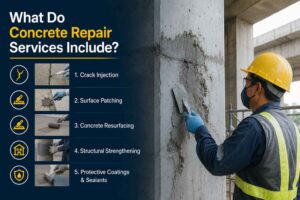
Professional repair services in Australia go far beyond filling cracks with cement. Depending on the extent of damage, here are the most common solutions:
- Crack Injection: Resin or epoxy injections fill deep cracks, bonding the structure and preventing water from sneaking in.
- Surface Patching: For minor chips or spalls, patching compounds smooth out the surface and restore functionality.
- Concrete Resurfacing: Instead of ripping out old slabs, a new layer of high-strength concrete overlay is applied. This is popular for driveways, patios, and commercial spaces where appearance matters.
- Structural Strengthening: Carbon fibre wraps or steel reinforcement restore load-bearing capacity for major issues like weakened beams or columns.
- Protective Coatings & Sealants: Protective coatings keep water, oil, and chemicals from penetrating the concrete to prevent future damage. It is essential in coastal areas where salt corrosion is common.
Residential Applications of Concrete Repair
Concrete isn’t simply used in businesses; it’s also used in residences all around Australia. This is where concrete repair services usually come in:
- Patios: fixing damage to the surface and sealing it against water.
- Pathways: Ensure the ground around your property is safe and level.
- Driveways: Fix cracks and places that are sinking before they become dangerous.
- Garages: Fixing floors that may have moved or cracked because of the weight of cars.
Many homeowners think that cracks are only “cosmetic.” But if you don’t fix them, they can lower the value of your property and make it less safe. Also, a driveway or patio that has just been fixed and resurfaced immediately makes the street look better.
Commercial and Industrial Applications of Concrete Repair
Concrete restoration services aren’t only about how things look for businesses but also about safety and following the rules.
- Car parks: Filling gaps and cracks keeps cars safe and stops accidents.
- Warehouses: Floors that are smooth and long-lasting make forklifts and other equipment last longer.
- Retail and Hospitality: Customers are more likely to have a good first impression if the surface is clean and cracks-free.
- Bridges and Infrastructure: Making sure the structure stays strong and lasts longer when there is a lot of traffic.
For property managers and authorities, fixing concrete early implies less danger of public liability and reduced long-term costs.
The Australian Advantage: Local Knowledge Matters
Concrete doesn’t do well in Australia’s weather. The coast has to deal with salt damage, the outback has to deal with excessive heat, and the south has to deal with freezing winters. That’s why knowing what you’re doing in your area is so important.
Australian concrete repair companies generally employ tools and materials that are made to work well in the area. For instance:
- UV-resistant coatings to handle harsh sunlight.
- Sealants are made to withstand high rainfall or humidity.
- Reinforcement strategies for high-traffic urban environments.
This local knowledge means repairs don’t just fix the issue, they future-proof it.
How Professionals Approach the Repair Process
A good repair job isn’t about slapping cement over cracks. Professionals usually follow a structured process:
- Inspection & Diagnosis: Understanding whether the issue is cosmetic or structural is key.
- Surface Preparation: Damaged sections are cleaned, sometimes with sandblasting or pressure washing, so the repair materials bond properly.
- Repair Application: Epoxy injections, resurfacing, patching, or strengthening, depending on the problem.
- Finishing & Sealing: The final touch protects the concrete from future damage.
- Maintenance Advice: Professionals often provide simple tips to extend the life of the repair, like resealing every few years.
The Bottom Line
Concrete may look like it can’t be broken, but the weather and heavy use will wear it down over time. The good news is that you don’t always have to get a new one. With the correct concrete repair services, you can make your concrete strong, long-lasting, and safe again without spending much money.
The message for homeowners, businesses, and authorities in Australia is clear: don’t ignore fractures or damage. Check them out, fix them, and keep your property safe and valuable. When it comes to concrete, a stitch in time saves nine.
Also Read:- Road Sweeping Services: Keeping Streets Clean and Safe
How to Make Repaired Concrete Last Longer
Concrete needs a little extra care once it has been fixed to stay in great shape:
- Drainage Maintenance: Check to see that water isn’t pooling near slabs.
- Regular Cleaning: Make sure surfaces are clean and free of oil, grime, and water.
- Resealing: Do this every few years, especially on driveways and other open places.
- Don’t overload: Don’t park huge trucks or machinery on surfaces not meant for them.
With the right care, rehabilitated concrete can survive another ten to twenty years.
FAQs
Q:- How long does it take to fix concrete?
Ans:- Competent repair and regular maintenance can make something last for 10 to 20 years, depending on how it is used and how much it is exposed to.
Q:- Is it possible to fix all of the cracks in concrete?
Ans:- Most of the time, all the cracks can be repaired, but if the slab is too damaged or unstable, it would be best to replace it.
Q:- Are concrete repair services in Australia expensive?
Ans:- Costs differ, but fixing the slab is usually less than replacing it.
Q:- Should you resurface concrete instead of replacing it?
Ans:- Resurfacing is a cheap approach to restoring appearance and function if the base is still strong.
Q:- Do the restored sections look like the rest of the concrete?
Ans:- Yes, new methods and finishes can make restored portions look like they belong on the same surface.