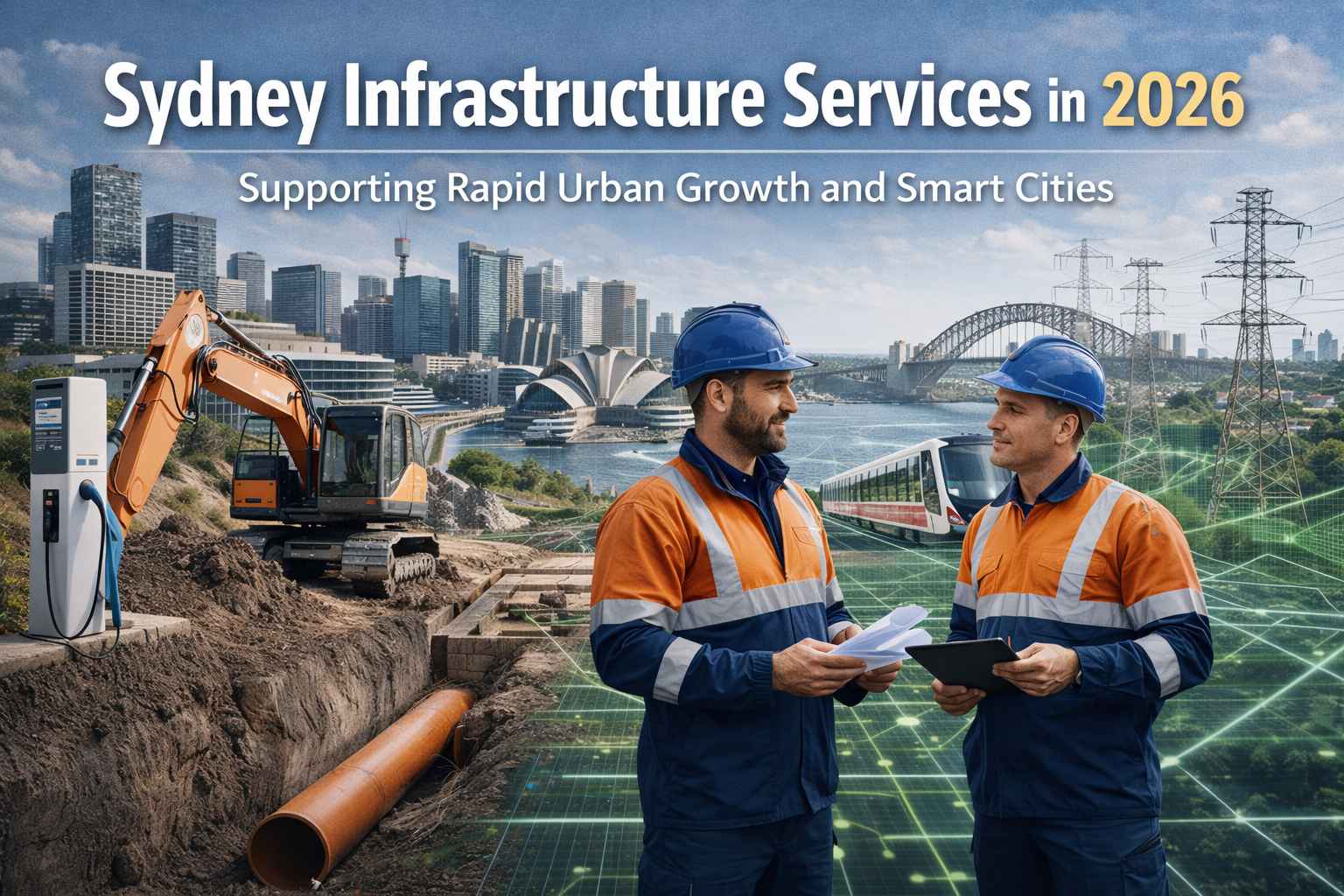
If you’ve taken a stroll through the CBD or driven out toward the Western Suburbs lately, you’ve probably noticed that Sydney looks a bit like a giant, high-tech construction site. But it’s not just “more traffic” or “more detours”, it’s the sound of a city reinventing itself.
As we move through 2026, Sydney infrastructure services are working overtime to keep up with a population that’s growing faster than a Bondi sunrise.
From the massive Western Sydney Aerotropolis to the “Smart City” sensors being embedded in our footpaths, the goal is simple: make Sydney liveable, breathable, and hyper-connected. Here’s a look at how the city is bracing for the future.
The “30-Minute City” Dream
The biggest buzzword in civil infrastructure services Sydney right now is the “30-minute city.” The idea is that no matter where you live—Penrith or Parramatta—you should be able to reach your work, school, and essential services within half an hour.
- To make this happen, the infrastructure focus has shifted from just “building more roads” to creating integrated transport hubs. We’re seeing a massive rollout of metro expansions that act as the city’s new spine.
- This isn’t just about trains; it’s about the services that connect them, like smart bike-sharing docks and pedestrian-friendly walkways that make the “last mile” of your commute a breeze.
Going “Smart” (Not Just Our Phones)
What makes Sydney infrastructure services in 2026 different from a decade ago? Data. Sydney is officially entering its “Smart City” era. It means that new civil projects aren’t just concrete and steel; they are embedded with technology.
- Waste Sensors: Public bins that alert council services when they’re full, optimising truck routes and keeping our parks cleaner.
- Smart Lighting: Streetlights that dim when no one is around to save energy but brighten instantly when they detect movement.
- Real-Time Traffic Management: AI-driven systems that adjust traffic light timings based on actual congestion, rather than just a pre-set timer.
The Western Sydney Revolution
You can’t talk about Sydney’s growth without mentioning the West. The civil infrastructure services Sydney is delivering in the Western Parklands are staggering.
- With the new airport nearing its full operational stride, the infrastructure isn’t just supporting houses; it’s supporting an entirely new economy.
- We’re talking about high-speed internet, sophisticated water recycling plants, and decentralised energy grids that help neighbourhoods stay resilient during our increasingly hot summers.
- It’s no longer about “Greater Sydney” being an extension of the coast; it’s about two major city hearts beating in sync.
Sustainability: The Green Undercurrent
In 2026, infrastructure isn’t considered “good” unless it’s also “green.” We are seeing a huge push toward “permeable” surfaces in our civil works.
We have pavements that allow rainwater to soak through into the ground rather than flooding the gutters. Sydney is also investing heavily in “Green Tracks” for light rail areas, where grass grows between the rails to reduce the “heat island” effect in the CBD.
Civilcraft: Pioneering Sydney’s Civil Infrastructure
As the city shifts toward a smarter and more sustainable future, specialised civil engineering firms are the ones doing the heavy lifting.
- Civilcraft has emerged as a key player in this space, acting as a trusted partner for both government bodies and private developers across the Greater Sydney region.
- We don’t just “pour concrete”; we specialise in delivering time-critical civil infrastructure services required to keep its busy airports, ports, and motorways operational without disruption. In 2026, Civilcraft is at the forefront of the “Green Infrastructure” movement.
- From implementing high-tech bitumen repairs that use recycled materials to designing advanced stormwater systems that mitigate urban heat, their work is a masterclass in future-proofing.
By integrating smart diagnostics and sustainable engineering, Civilcraft ensures that Sydney’s growth isn’t just rapid, but resilient. Whether it’s maintaining the vital road networks or delivering complex structural foundations for new industrial hubs, we provide the technical backbone.
Resilient Design: Preparing for Sydney’s Climate Future
In 2026, Sydney infrastructure services are no longer just about building for today; they are about surviving tomorrow.
- With climate resilience now a core pillar of the NSW Government’s “Decarbonising Infrastructure Delivery Roadmap,” new projects are being designed to withstand extreme weather—from flash flooding to heatwaves.
- We’re seeing a rise in “cool pavements” and the large-scale use of recycled crushed concrete in motorway projects like the M12.
By shifting to a circular economy model, civil infrastructure services are successfully reducing the city’s carbon footprint while ensuring that our vital transport and water networks remain robust in the face of environmental change.
Also Read:- Road Bitumen Repair in 2026 : New Technologies Improving Road Durability in Australia
The Road Ahead
Sydney is at a tipping point where the old-school charm of the Harbour Bridge meets the futuristic tech of a global mega-city. While the construction noise can be a headache, the result is a Sydney that is more accessible and sustainable than ever before.
The next time you see a new rail line or a tech-enabled park popping up, remember: it’s all part of the Sydney infrastructure services, which is a blueprint to keep Sydney one of the best places to live on the planet.
FAQs
Q:- What exactly are Sydney infrastructure services?
Ans:- They are the essential systems that keep the city running—think transport (trains/roads), water, electricity, telecommunications, and public spaces like parks and plazas.
Q:- How do civil infrastructure services benefit daily commuters?
Ans:- By integrating “Smart” technology, these services reduce bottlenecks, provide real-time transit updates, and create safer, more efficient routes for both drivers and public transport users.
Q:- Is Sydney becoming a “Smart City”?
Ans:- Yes! By 2026, Sydney will have integrated IoT (Internet of Things) sensors into everything from parking meters to air quality monitors to improve urban living.
Q:- What is the Aerotropolis?
Ans:- It’s a massive infrastructure project in Western Sydney centred around the new airport, designed to create thousands of jobs in tech, logistics, and education.
Q:- How does new infrastructure help with climate change?
Ans:- Current projects focus on “resilient design,” using recycled materials, increasing urban canopy cover, and improving stormwater management to handle extreme weather.