If you’ve taken a stroll through the Sydney CBD or grabbed a coffee in Surry Hills lately, you might have noticed things are changing. It’s not just the new light rail or the ever-shifting skyline—it’s the bins. Specifically, what we’re putting in them and who is coming to pick them up.
Welcome to 2026. This year marks a massive turning point for waste management Sydney, and if you’re a business owner or a curious resident, you’ve likely felt the shift. We’ve moved past the “just throw it in the red bin” era.
Today, waste management services in Sydney are high-tech, highly regulated, and focused on one big goal: a circular economy. Let’s break down what’s actually happening on the ground and why 2026 is the “Year of the Organics.”
The FOGO Revolution: July 1 is the Date to Watch
If there’s one phrase you’ll hear on repeat this year, it’s FOGO (Food Organics and Garden Organics). As of July 1, 2026, the NSW Government has officially flipped the switch on a landmark mandate. This isn’t just a “suggestion” anymore.
The largest food waste generators in Sydney, including supermarkets, large hospitality venues, hospitals, and shopping centres with over 1,000 square metres of space, are now required by law to separate their food waste from general rubbish.
Why the rush? Greater Sydney’s landfills are predicted to reach capacity by 2030. We’re literally running out of space to bury our scraps. By pulling food out of the “red bin” and into a dedicated organic stream, we aren’t just saving space; we’re reducing methane emissions and turning that “waste” into high-quality compost for NSW farmers.
Smarter Services: AI is the New Garbage Man
In 2026, waste management services aren’t just about trucks and muscles. They’re about data. The industry has gone through a massive digital facelift.
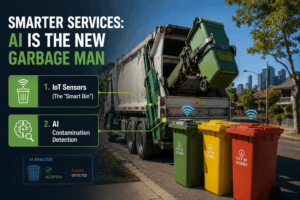
1. IoT Sensors (The “Smart Bin”)
- Gone are the days of garbage trucks rumbling down a quiet street only to pick up a half-empty bin. Many commercial bins across Sydney are now fitted with IoT sensors.
- These little devices tell the service provider exactly how full the bin is. If it’s empty, the truck skips it. It reduces traffic congestion (a win for Sydney drivers!) and slashes CO2 emissions.
2. AI Contamination Detection
- This is where it gets a bit “Sci-Fi.” Some of the top waste management services in Sydney are now using AI cameras on their trucks.
- As the bin is tipped, the camera scans for “interlopers”, like a plastic bag in the recycling bin or a glass bottle in the FOGO bin. Businesses get real-time feedback to improve their sorting, ensuring the city’s recycling stream stays pure.
Plastics Plan 2.0: The War on Single-Use Continues
Remember when we thought banning plastic straws was the final boss? That was just the beginning. Under the NSW Plastics Plan 2.0, 2026 is a transition year for even more bans.
- Lighter-than-air balloons:- Say goodbye to those helium releases; they’re officially off the guest list for events.
- The “Red & Green” Chemical Lists:- The EPA has introduced a strict list of chemicals allowed in plastic packaging. If it’s on the “red list” (toxic additives), it’s being phased out to ensure our recycled plastic is actually safe to reuse.
For Sydney businesses, this means working closely with their waste management services to audit what’s coming in as much as what’s going out. It’s all about “designing out” waste before it even reaches the bin.
The Circular Economy: More Than a Buzzword
In 2026, “waste” is being rebranded as “resources.” We’re seeing a boom in local processing facilities. Instead of shipping our plastic and paper overseas, new infrastructure in Western Sydney is turning our yellow-bin contents into new glass bottles, cardboard packaging, and even road base.
For the average Sydneysider, this means your waste management experience is becoming more transparent. You can now track where your recycling goes, with many councils and private providers offering apps that show the “journey of the jug” from your kerbside to a new product.
Also Read:- Sydney Infrastructure Services in 2026: Supporting Rapid Urban Growth and Smart Cities
Final Thoughts: Adapt and Thrive
Waste management services by Civilcraft aren’t the “invisible” services they used to be. It’s the front and centre of how we live and do business in Sydney.
Whether you’re a cafe owner in Newtown or managing an office block in Parramatta, staying ahead of the 2026 regulations isn’t just about avoiding fines. It’s about being part of a city that’s finally learning how to stop wasting its potential.
FAQs
Q:- Does my small business have to start FOGO recycling this year?
Ans:- If you generate more than 3,840 litres of residual waste per week, yes—the mandate starts July 1, 2026. Smaller businesses have until 2028 or 2030, depending on their size.
Q:- Can I still use “compostable” plastic bags in my FOGO bin?
Ans:- Only if they meet the strict Australian Standards (AS 4736) and are approved by your specific waste provider, many “degradable” plastics are still banned because they just break down into microplastics.
Q:- What happens if I accidentally put the wrong thing in the smart bin?
Ans:- Most waste management services now use AI to spot contamination. You’ll likely receive a digital notification or an educational report. Repeated issues, however, can lead to service surcharges or fines.
Q:- Are there grants to help my business upgrade our bins?
Ans:- Yes! The NSW EPA’s Bin Trim program is still active in 2026, offering rebates and free audits to help Sydney businesses transition to better recycling systems.
Q:- When will households get the new FOGO bins?
Ans:- While many councils (like Inner West and Randwick) already have them, all Sydney councils are required to provide a FOGO service to residents by 2030.