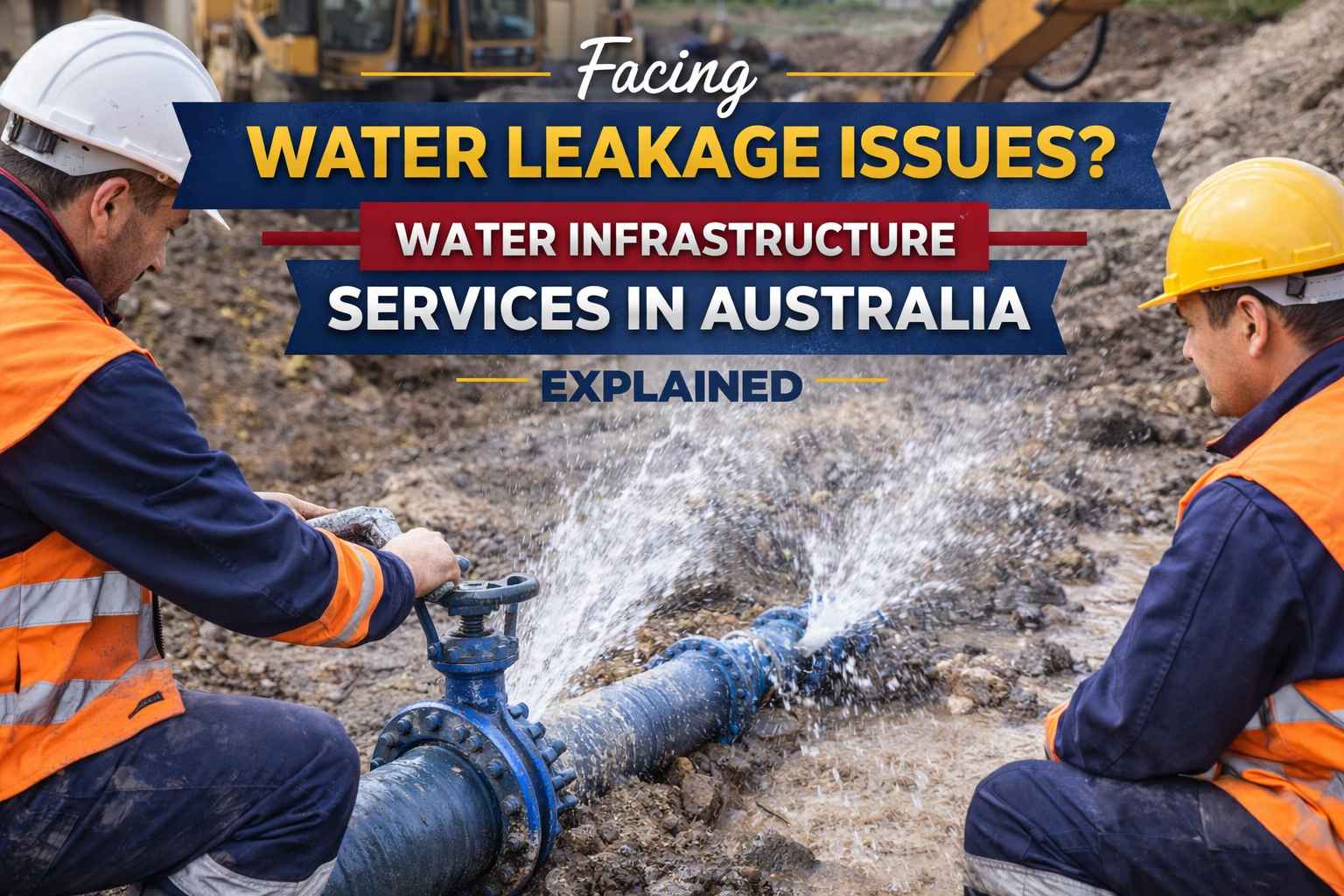
It happens to the best of us. You’re standing in the kitchen, it’s 11:00 PM, and you hear that rhythmic, maddening drip… drip… drip. Or worse, you walk out to the driveway and notice a mysterious, bubbling puddle that definitely wasn’t there this morning.
Whether it’s a pinhole leak in a residential pipe or a massive burst flooding a Sydney intersection, water leakage is more than an annoyance; it’s a challenge for our city’s skeleton.
In Australia, particularly as we move through 2026, managing our liquid gold is a high-tech game. If you’ve ever wondered how the water gets from a massive dam to your morning coffee without disappearing into the Earth, it’s all thanks to water infrastructure services.
Let’s dive into why leakage happens, how the experts fix it, and why civil construction services are the real heroes behind the scenes.
Why Australia is Obsessed with Water Infrastructure
Australia is the driest inhabited continent on Earth. We don’t have the luxury of wasting a single drop. Yet, our underground pipe networks are aging. In cities like Sydney, Melbourne, and Brisbane, some of the cast-iron pipes humping water around were laid down over a century ago.
When these pipes fail, it’s not just about the water lost. It’s about the erosion of roads, the flooding of basements, and the massive energy cost of pumping water that never reaches a tap.
This is why water infrastructure services have shifted from “reactive” (fixing it when it breaks) to “predictive” (fixing it before it breaks).
The Role of Civil Construction Services
You might think of “civil construction” as just building bridges or high-rises. However, civil construction services are the backbone of water management.
When a new suburb is built in Western Sydney, civil contractors aren’t just paving roads; they are laying kilometres of high-density polyethylene pipes, building pumping stations, and installing massive reservoirs.
Without these services, the “taps” simply wouldn’t work. They provide the literal groundwork that allows water utilities to function.
The “Silent Killers”: Detecting Hidden Leaks
The scariest leaks are the ones you can’t see. Across Australia, thousands of litres are lost every day through “non-revenue water”, leaks that happen underground and never surface. Modern water infrastructure services now use some pretty “sci-fi” tech to hunt these down:
- Acoustic Sensors: Professionals “listen” to the pipes. High-pitched frequencies often indicate a pressurised leak.
- Smart Meters: These track water flow in real-time, alerting the provider if there’s a spike in usage that suggests a burst.
- Satellite Imaging: Some major Australian utilities use satellite data to detect the spectral signature of treated water in the soil from space!
Breaking Down Water Infrastructure Services

What does “infrastructure service” look like on the ground? It’s usually a three-stage process:
1. Planning & Design
- Before a shovel hits the dirt, engineers map out the flow. It involves hydraulic modelling to ensure that when everyone in a high-rise turns on their shower at 7:00 AM, the pressure doesn’t drop to a trickle.
2. Implementation (The Heavy Lifting)
This is where civil construction comes in. This stage involves:-
- Trenchless Technology: Instead of digging up a whole road, contractors use “micro-tunnelling” or “pipe bursting” to replace old lines from the inside out.
- Reservoir Construction: Building those massive concrete tanks you see on hillsides to maintain gravity-fed pressure.
3. Maintenance & Asset Management
- Once the pipes are in, they need care. It includes regular pressure cleaning of sewer lines to prevent “fatbergs” and relining old pipes with epoxy resins to give them another 50 years of life.
Why Is Leakage Increasing?

If you feel like you’re seeing more “Road Work” signs and water main breaks lately, you’re not imagining it. Several factors are putting pressure on Australia’s water systems in 2026:
- Climate Variability: Extreme wet-to-dry cycles cause the Australian clay soil to expand and contract, which snaps old, rigid pipes like toothpicks.
- Urban Density: We are cramming more people into the same city footprints. Old pipes designed for a few houses are now feeding 20-story apartment blocks.
- Construction Vibration: Ironically, the massive boom in other civil construction (like new metro tunnels) can sometimes vibrate the ground enough to disturb sensitive, aged water junctions.
The Future: “Smart” Water Cities
We are moving toward a “Digital Twin” model for water. Imagine a digital 3D map of Sydney where every pipe glows green if it’s healthy and flashes red if the pressure drops.
Contractors like Civilcraft are at the forefront of this, integrating sensor technology into the very fabric of the civil works they install. By combining traditional civil construction with modern data, we aren’t just building pipes; we’re building a “nervous system” for the city’s water.
Also Read:- A Complete Guide to Civil Infrastructure Contractors in Sydney
Conclusion: Why Civilcraft Wins
Facing water leakage at a precinct or municipal level requires more than just a plumber; it requires a specialised vision of the entire urban landscape. Civilcraft has established itself as the premier choice for water infrastructure services in Australia.
Our ability to blend heavy-duty civil construction with precision engineering makes us the best in the business for ensuring our most precious resource gets exactly where it needs to go.
FAQs
Q:- What are water infrastructure services?
Ans:- These are professional services that design, build, and maintain the systems used to supply, treat, and manage water and wastewater across a city or region.
Q:- How do civil construction services help with water issues?
Ans:- Civil contractors handle the physical labour and engineering—like excavating trenches, laying massive pipelines, and building pump stations—that allow water systems to exist.
Q:- Why do pipes leak more in the Australian summer?
Ans:- The heat causes soil to dry out and shrink, which removes the support around underground pipes, causing them to shift and eventually crack or burst.
Q:- What is trenchless pipe repair?
Ans:- It’s a modern method used by infrastructure contractors to fix or replace underground pipes with minimal digging, often by “lining” the old pipe with a new, durable material.
Q:- How can I tell if there’s a major leak near my property?
Ans:- Look for unexplained damp patches in the garden, a sudden drop in water pressure, or the sound of running water when all your taps are turned off.