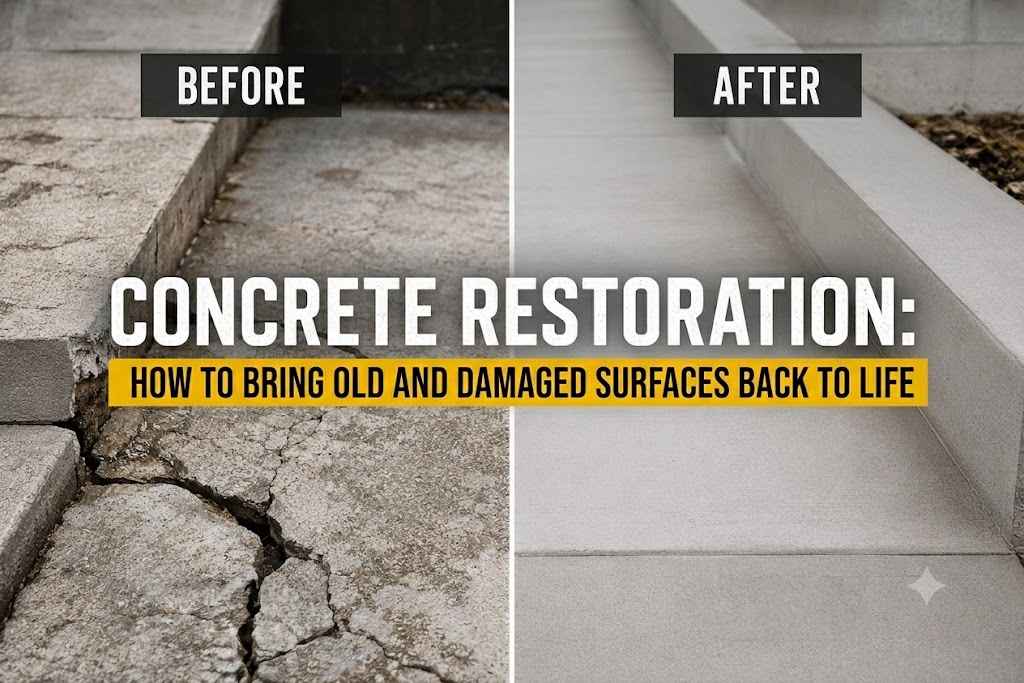
Walk around any commercial asset, industrial site, or major piece of infrastructure in Australia, and you will see it everywhere: concrete. It is the literal foundation of our modern world. But while concrete looks tough and permanent, it isn’t immortal.
Over time, the harsh Australian sun, heavy traffic loads, moisture, and chemical exposure take a serious toll. Before you know it, that smooth, pristine slab develops cracks, starts spalling (flaking off), or looks completely worn out.
When a surface reaches that point, asset managers often face a major dilemma: do you tear it all out and start fresh, or can it be saved? Here at Civilcraft, we deal with this exact scenario every single day in the form of concrete restoration.
As specialists in infrastructure maintenance, we are here to tell you that you don’t always need to bring in the demolition crew. Concrete restoration can breathe brand-new life into tired, degraded surfaces, saving you time, money, and structural headaches.
Let’s break down how the process works, how to choose the right approach, and why saving your existing concrete is often the smartest move you can make.
What is the Difference Between Concrete Repair and Restoration?
It is incredibly common to hear people use these two terms interchangeably, but in the civil and commercial construction world, they mean completely different things. Understanding the distinction is vital for planning your maintenance budgets effectively.
-
Concrete Repair:
Think of this as targeted first aid. Concrete repair focuses on fixing a specific, isolated issue to stop it from getting worse.
If you have a single deep pothole in a car park, a localised crack on a loading dock, or a small patch of rust-stained concrete caused by internal steel corrosion (concrete cancer), you apply a targeted patch. You are fixing the immediate symptom.
-
Concrete Restoration:
It is a comprehensive overhaul. Restoration looks at the entire asset to bring it back to its original performance, structural integrity, and appearance.
The process involves trying to determine why the damage occurred in the first place, fixing any underlying problems, repairing the surface and applying protective coatings to ensure the damage is not repeated.
Restoration is a holistic process at Civilcraft. We don’t just patch cracks – we design a long-term solution that guarantees that the asset will be able to handle the operational environment it was designed for for years to come.
Is Concrete Restoration Cheaper Than Replacement?
Absolutely, in the vast majority of cases. Repairing concrete instead of replacing it is a far more economical solution, and the savings go far beyond the cost of the materials themselves. When you decide to replace a concrete slab completely, you aren’t just paying for the new pour.
- You have to consider the massive labor costs of jackhammering the old concrete, loading it into trucks, paying heavy disposal and recycling fees at the tip, re-leveling the sub-base, and setting up new formwork.
- Worse yet is the operational downtime. New concrete takes days, sometimes weeks, to fully cure and reach its design strength. For a busy commercial facility, warehouse, or public asset, closing down operations for that long can cost a fortune in lost revenue.
- Concrete restoration minimises all of these headaches. By utilising advanced engineering techniques, we can target the exact weak points, reinforce the slab, and have your site back up and running in a fraction of the time, for a fraction of the cost.
High-Performance Structural Concrete Repair
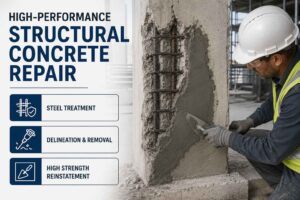
When concrete is part of a load-bearing structure, like a bridge deck, a multi-story car park, or an industrial retaining wall, damage isn’t just an eyesore; it is a serious safety hazard.
This is where structural concrete repair becomes absolutely critical. Structural degradation often happens due to a process called carbonation or chloride contamination.
It causes the internal steel reinforcement to rust. As the steel rusts, it expands, cracking the surrounding concrete from the inside. When we do structural repair, our process is meticulous:
- Steel Treatment: Blast cleaning of rust from exposed steel reinforcement and application of protective anti-corrosion coatings.
- Delineation & Removal: We mechanically remove the damaged, weakened concrete until sound, healthy material is exposed.
- High Strength Reinstatement: Structural profile is reinstated using specialised structural mortars or polymer-modified micro-concretes.
Modern Concrete Resurfacing Solutions
What if your concrete is structurally rock-solid, but the surface looks unappealing, heavily eroded, or has micro-cracking across the top layer? You don’t need heavy structural intervention here; instead, you need modern concrete resurfacing solutions.
- Resurfacing bridges the gap between raw utility and clean aesthetics. By applying premium polymer-modified cementitious overlays or epoxy-based coatings, we can create a completely seamless, fresh top layer directly over your old concrete.
- These coatings can be finished with certain slip-resistant textures, making them perfect for public walkways, factory floors and commercial driveways.
- These solutions not only hide existing imperfections, but protect the concrete underneath from future chemical spills, moisture penetration and heavy tyre wear.
Also Read:- Pathway Maintenance: How to Prevent Cracks, Trips and Surface Damage
Why Partner with Civilcraft?
Partnering with us for concrete restoration means understanding compliance, safety and long-term asset value in the management of commercial and civil infrastructures. At Civilcraft, we don’t do quick fixes or cosmetic cover-ups.
Our processes comply with Australian standards, supported by decades of combined industry experience across all sites. We manage the entire project, from initial diagnostics to the final protective coating, so you can keep your facilities safe, compliant and operating.
FAQs
Q:- Can stained concrete be restored?
Ans:- Yes, definitely! If you have oil, chemical or tyre stains that are deeply embedded, it doesn’t mean the concrete is ruined. We use industrial-strength chemical degreasers, diamond grinding or shot-blasting to strip the contaminated top layer, leaving a clean, open-pored profile.
Q:- How long does concrete restoration last?
Ans:- When done right with high-quality materials, a professional concrete restoration can easily last 15 to 25+ years. The exact lifespan will depend on the amount of heavy traffic it receives, exposure to the weather and whether you invest in routine sealing maintenance down the track.
Q:- Can cracked concrete always be saved?
Ans:- Not necessarily, but most of the time it can. Low-viscosity epoxy or polyurethane injections can permanently stabilise fine hairline cracks and structural fractures. But a partial replacement might be required if the slab has buckled completely.
Q:- What is concrete cancer?
Ans:- The corrosion of internal steel reinforcement that causes spalling is often referred to as concrete cancer. The steel in the concrete is exposed to moisture and air, and the metal rusts and expands. The concrete cracks and breaks off.
Q:- How soon can traffic return to the restored concrete?
Ans:- It all depends on what products you use. Traditional concrete can take days to cure; we often use fast-setting structural mortars and high-tech polyaspartic coatings that can accept heavy vehicle traffic within hours of application, limiting your downtime.