Think about the last time you drove through a major intersection during a heavy downpour, or navigated a massive, multi-level commercial car park. What kept you from drifting into oncoming traffic or clipping a concrete pillar? It wasn’t guesswork; it was those crisp, bright lines painted precisely on the asphalt.
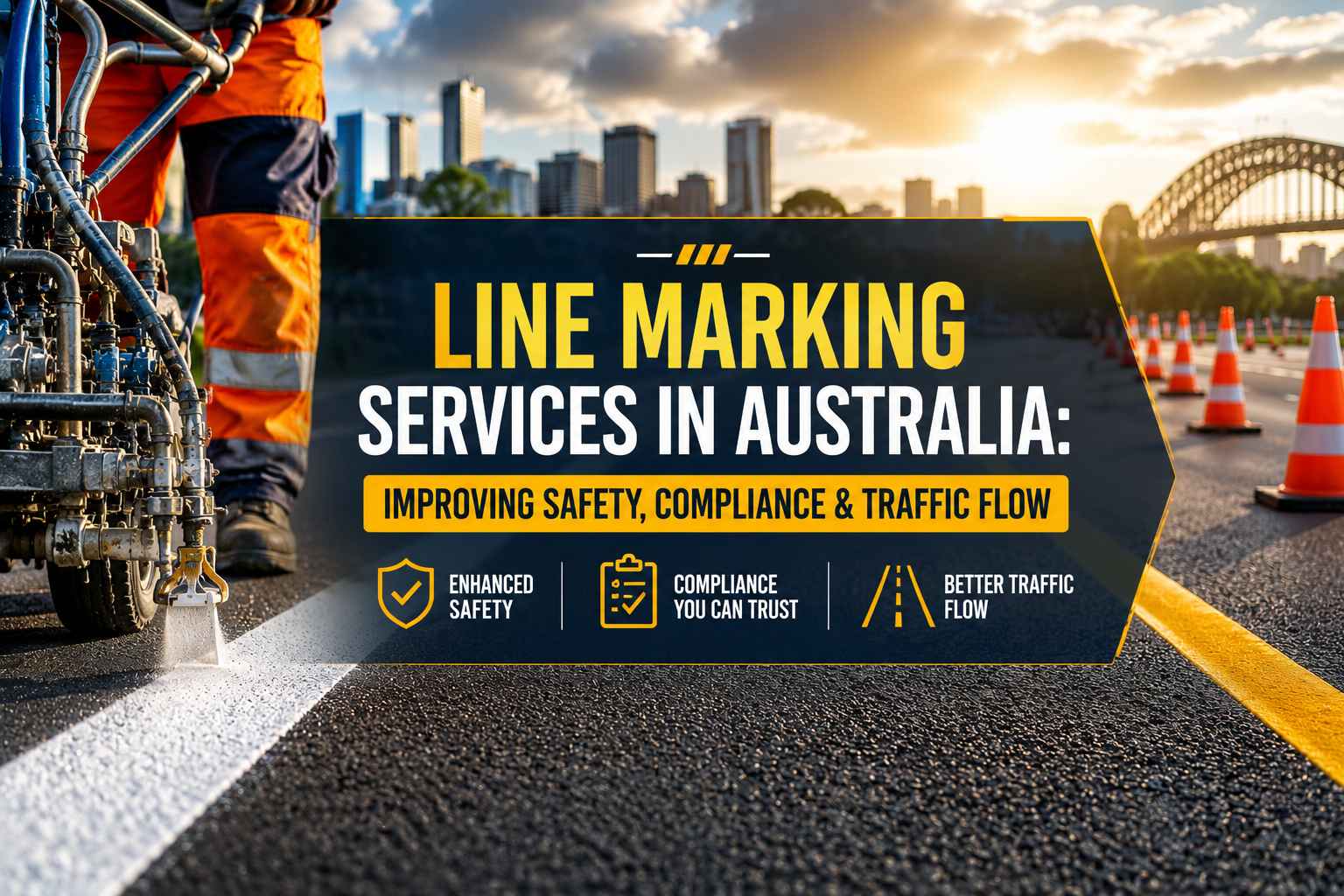
We often treat road markings like part of the scenery, but the truth is that line marking services are the silent orchestrators of our daily commute. From local suburban streets and school zones to massive industrial warehouses and private commercial facilities, high-quality pavement markings keep Australia moving predictably and safely.
If you manage a commercial property, coordinate council infrastructure, or handle workplace health and safety, getting your line marking right isn’t just about aesthetics. It is a fundamental pillar of public safety and legal compliance. Let’s dive into why these markings matter, what regulations dictate their design, and how the right infrastructure team makes all the difference.
The Core Pillars: Safety, Compliance, and Flow
When we talk about professional road line marking, we are looking at three distinct operational benefits that directly impact anyone using a transport network or commercial space.
Why are Line Marking Services Important for Road Safety?
At its absolute core, line marking is visual communication. It establishes structural boundaries, delineates lanes, highlights pedestrian crossings, and warns drivers of upcoming hazards (like school zones, sharp bends). Without clear visual guidance, drivers instinctively hesitate, leading to erratic braking, rear-end collisions, and side-swipe accidents.
Furthermore, high-quality modern markings utilize retroreflective glass beads. When vehicle headlights hit these lines at night or during heavy torrential rain, the light bounces directly back to the driver’s eyes, keeping them safely centered in their lane when visibility drops to near zero.
Streamlining Traffic Flow
- Ever been in a poorly marked car park or a chaotic freight loading dock? It’s a frustrating nightmare. Clear car park line marking, directional arrows, and boxed “Keep Clear” zones eliminate confusion.
- By telling drivers exactly where to go, where to park, and who has the right-of-way, professional line placement maximises spatial efficiency and reduces congestion during peak hours.
WHS and Public Compliance
If you operate an industrial site or a logistics warehouse, your line marking is a vital piece of safety infrastructure. Clear boundaries separate heavy machinery—like forklifts—from foot traffic walkways. Failing to maintain these visible safety zones can result in severe workplace accidents, hefty regulatory fines, and massive insurance liabilities.
Understanding the Variety: Materials and Service Types
Not all lines are drawn with the same brush. Different environments demand completely different applications and chemical compositions to handle heavy tyres and harsh Australian UV exposure.
Types of line marking services in Australia
- Cold Applied Plastic (CAP): Known for its extreme durability and skid resistance. It’s frequently used for high-friction areas like pedestrian crossings, transit bus lanes, and bright green bicycle pathways.
- Waterborne Paint Markings: The most traditional and cost-effective method. It dries incredibly fast and is ideal for low-to-medium traffic environments like local car parks, school sports courts, and temporary construction lanes.
- Epoxy and Polyurethane Coatings: Primarily used indoors for industrial warehouses, factories, and underground basement car parks. These chemicals bond beautifully with concrete surfaces, resisting chemical spills and heavy forklift scrubbing.
- Thermoplastic Line Marking: This is the gold standard for public roads and high-traffic highways. A solid block of plastic material is melted at high temperatures (around 200°C) and fused directly onto the asphalt. It is exceptionally durable, highly reflective, and can withstand millions of vehicle movements.
Navigating the Legal Framework: The Australian Standards
You can’t just go out with a can of spray paint and draw lines wherever you please. Australia has incredibly strict guidelines to ensure that a driver from Brisbane can effortlessly understand the roads in Melbourne or Sydney.
What are the Standards for Line Marking in Australia?
Public road networks across the country must strictly comply with Australian Standard AS 1742 (Manual of Uniform Traffic Control Devices). This comprehensive standard outlines the precise width of lines (typically 100mm for standard lanes), the exact length-to-gap ratios for broken lines, and the specific shape of arrows.
For instance, AS 1742 dictates that white is used for standard lane delineation, while yellow is strictly reserved for parking controls and no-stopping restrictions. For commercial parking facilities, developers must adhere to AS/NZS 2890.1, which establishes legal bay sizes, proper allocation widths for accessible parking, and safe clearance zones for pedestrian walkways.
Lifecycle and Budgeting: When to Refresh and What it Costs

Because lines constantly battle heavy traffic friction, scorching summer heat, and rain, they eventually degrade. Managing their upkeep is a balancing act of timing and budget.
How and When Should Road Line Markings Be Refreshed in Australia?
The lifespan of a marking depends heavily on the volume of traffic and the material used.
- Standard waterborne paint in high-traffic commercial zones (like a busy supermarket car park) usually requires a refresh every 12 to 24 months.
- Heavy-duty thermoplastic markings on regional roads or industrial thoroughfares can comfortably stretch anywhere from 5 to 8 years before losing their structural integrity or reflectivity.
- Rule of Thumb: If lines are noticeably faded during night driving or rainy conditions, an audit and refresh should be booked immediately to avoid liability risks.
Cost of Line Marking Services in Australia
Because every project varies drastically in layout complexity, surface condition, and size, costs are calculated across different metrics:
- Car Park Spaces:- Standard parking bays typically range from $5 to $15 per bay for simple painted lines.
- Custom Symbols:- Large disabled icons, pedestrian shared-zone stencils, or custom company logos are priced per unit depending on complexity and color requirements.
- Linear Road Markings:- Highly durable thermoplastic longitudinal lines generally average between $20 and $50 per linear metre, depending on the scale of mobilization.
Also Read:- Water Infrastructure Services in Australia: Building Reliable Water Networks for the Future
Partnering with the Experts: Civilcraft
When it comes to building, maintaining, and future-proofing civil infrastructure, cutting corners on your line marking is never an option. That is why smart property managers, commercial developers, and local councils partner with Civilcraft.
As a trusted leader in comprehensive civil construction and infrastructure management, Civilcraft delivers world-class line marking services that seamlessly meet the rigorous demands of Australian Standards and WHS compliance.
Whether you are laying down heavy-duty thermoplastic lines for a high-volume road network, executing a complex commercial car park layout, or zoning out protective walkways in a busy warehouse, Civilcraft combines state-of-the-art technology with seasoned on-site expertise.
We understand that clear lines mean safe operations. Don’t leave your site compliance or public safety to chance. Reach out to the professional team at Civilcraft today to discuss your next marking, resurfacing, or civil asset management project!
FAQs
Q:- Why are line marking services important for road safety?
Ans:- They give drivers clear visual boundaries, guide traffic flow, highlight hazards, and use reflective materials to prevent accidents during heavy rain and dark nights.
Q:- How often should road line markings be refreshed in Australia?
Ans:- Standard paint on busy roads or commercial car parks needs a refresh every 12 to 24 months, while heavy-duty thermoplastic lines can last 5 to 8 years.
Q:- What are the Australian standards for line marking?
Ans:- Public roads must strictly follow AS 1742 for line widths, colors, and layouts, while commercial parking facilities must comply with AS/NZS 2890.1 for bay sizes.
Q:- What types of line marking services are available?
Ans:- The main options are fast-drying waterborne paint, ultra-durable thermoplastic (melted plastic), high-friction Cold Applied Plastic (CAP), and chemical-resistant epoxy coatings for indoor warehouses.
Q:- How much do line marking services cost in Australia?
Ans:- Costs vary by material and scale, typically averaging $5 to $15 per parking bay for basic paint, and $20 to $50 per linear metre for heavy-duty thermoplastic road lines.