
If you have ever driven down a smooth new stretch of highway, caught a train from a freshly upgraded station, or simply turned on your tap to get clean water, you have experienced the handiwork of a civil construction company.
While regular building construction focuses on houses and office high-rises, civil construction is all about the “big picture” foundational pieces that keep Australia moving. It is the unheralded backbone of our everyday lives.
From massive transport corridors to the structural engineering required to withstand intense weather, civil construction builds and maintains the shared public spaces we rely on. Let’s dive into exactly how a civil construction company functions, what they build, and how the industry is rapidly changing.
What Services Do Civil Construction Companies Provide in Australia?
Civil contractors work on a massive scale, moving mountains of earth and pouring tonnes of concrete. Their core expertise spans public infrastructure, heavy industrial sites, and urban development. The typical services they offer include:
- Earthworks and Site Preparation: Before any major structure goes up, thousands of tonnes of soil must be excavated, graded, and leveled. It includes deep trenching, rock breaking, and land clearing.
- Water and Wastewater Infrastructure: Civil crews are responsible for laying kilometers of heavy-duty piping for stormwater drainage, sewage systems, and main water lines, alongside constructing major water treatment facilities.
- Road, Highway, and Bridge Construction: From local council road upgrades to major interstate highway duplications, civil teams lay the sub-grade, base courses, and asphalt. They also construct the complex structural piers and spans for bridges.
- Subdivision and Land Development: When a raw piece of land is converted into a residential estate or commercial park, civil contractors step in to install all underground utilities (gas, power, telecommunications), roads, and retaining walls.
What is the Difference Between Civil Construction and Commercial Construction?
It is incredibly common to mistake these two fields, but they serve entirely different purposes and operate in separate environments. Commercial construction builds on top of the land, while civil construction prepares and shapes the land itself to support society.
|
Feature |
Civil Construction | Commercial Construction |
|
Primary Focus |
Public infrastructure, transport, and utilities. |
Business spaces, retail, offices, and large residential high-rises. |
|
Main Elements |
Bridges, highways, dams, tunnels, and airfields. |
Skyscrapers, shopping malls, hotels, and hospitals. |
|
Primary Client |
Government bodies (local, state, federal) or industrial giants. |
Private developers, corporations, and commercial real estate firms. |
| Engineering Focus | Heavy civil engineering, hydraulics, and geotechnics. |
Structural, architectural, and internal building systems. |
What Are the Latest Civil Construction Trends in Australia?
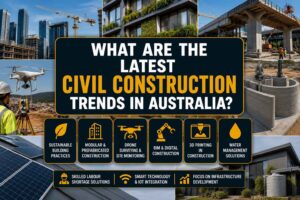
The civil landscape is evolving rapidly to meet new environmental regulations and technological demands. The major trends transforming Australian jobsites focus heavily on efficiency and footprint reduction:
- Sustainability and Circular Economy: Roads and structural bases are no longer just conventional concrete and asphalt. Contractors are increasingly utilising low-carbon concrete mixes, recycled crushed glass, and recycled asphalt pavement to align with strict state sustainability codes.
- Modern Methods of Construction (MMC): To tackle ongoing skilled labor shortages, there is a substantial shift toward off-site prefabrication. Large bridge beams, drainage pits, and retaining walls are manufactured in controlled factories and trucked in for rapid installation, reducing site disruption.
- Advanced Digital Integration: The industry has moved away from paper designs. Modern sites leverage Building Information Modeling (BIM) and digital twins to map out underground assets precisely. Artificial intelligence is also being deployed at scale for automated resource scheduling and predictive risk management.
How Do I Choose a Civil Contractor for an Infrastructure Project?
Selecting the right partner can determine whether a project finishes smoothly or faces costly delays. When vetting a civil construction company, keep these core pillars in mind:
1. Verification of Capabilities and Plant Fleet
- Ensure the company owns or has reliable access to a well-maintained heavy machinery fleet (excavators, graders, compactors). More importantly, verify they have proven experience executing the specific scope of work you require, whether that is intricate marine piling or deep utility laying.
2. Safety and Compliance Accreditations
- Australian civil sites operate under strict regulatory oversight. A reputable contractor must hold valid state licenses and international standards accreditations (like ISO 45001 for safety, ISO 14001 for environment, and ISO 9001 for quality). Ask to see their past safety record and Traffic Management plans.
3. Clear Financial Standing and Risk Management
- Given high material-price volatility and labor constraints, ensure the contractor has a solid financial baseline to handle long-lead procurement. Look for transparent contract structures with well-defined escalation clauses and variation protocols to protect your margins.
Also Read:- How to Repair Concrete Cracks in Australia: Causes, Solutions & Long-Term Prevention
Conclusion
Building the foundational infrastructure that keeps our communities safe, connected, and functional requires specialised expertise, precision engineering, and heavy-duty capabilities.
From massive highway networks and vital water systems to the ground preparation required for large-scale developments, a professional civil construction company is the driving force behind Australia’s growth.
As the industry moves toward greener materials, advanced digital mapping, and smarter engineering practices, choosing a highly accredited and financially stable civil contractor is essential for delivering public and private infrastructure on time and within budget.
Ultimately, these complex, large-scale projects shape the physical landscape of the nation, ensuring that our cities and regional centers are robust enough to withstand the demands of tomorrow.
FAQs
Q:- How much do civil construction projects cost in Australia?
Ans:- Civil costs vary immensely based on geotechnical conditions and project scale. Small civil works or utility connections might range from $15,000 to over $100,000, while regional road upgrades and major public infrastructure assets frequently scale from millions to billions of dollars.
Q:- What machinery does a civil construction company use?
Ans:- They utilise heavy-duty earthmoving plant equipment, including hydraulic excavators, bulldozers, articulated dump trucks, front-end loaders, backhoes, asphalt pavers, and smooth-drum or padfoot rollers.
Q:- Who typically hires a civil construction company?
Ans:- The primary clients are federal, state, and local government bodies (like transport and water authorities). However, private mining companies, energy firms, and residential land developers hire them frequently for major enabling works.
Q:- Why is geotechnical reporting essential before civil works begin?
Ans:- A geotechnical report analyses soil stability, rock layers, and water tables. Understanding the underground conditions prevents catastrophic foundation failures, landslides, or unexpected excavation delays once heavy machinery rolls in.
Q:- What is “enabling infrastructure” in civil construction?
Ans:- Enabling infrastructure refers to the foundational power, water, drainage, and road connections built first to allow a primary asset—such as a new housing estate, school, or hospital—to break ground and operate safely.