We take the roads we drive on, the bridges we cross, and the water systems piped into our homes completely for granted, right up until a water main bursts, a pothole blows out a tire, or a major highway bridge gets closed indefinitely for emergency structural repairs.
When infrastructure breaks down, daily life comes to a grinding halt. It’s expensive, deeply inconvenient, and sometimes outright dangerous.
The secret to keeping a modern community running isn’t just building bigger structures; it’s caring for the ones we already have. That’s where preventative infrastructure maintenance comes in. Instead of waiting for things to crumble, it’s about staying two steps ahead.
What is Preventative Infrastructure Maintenance?
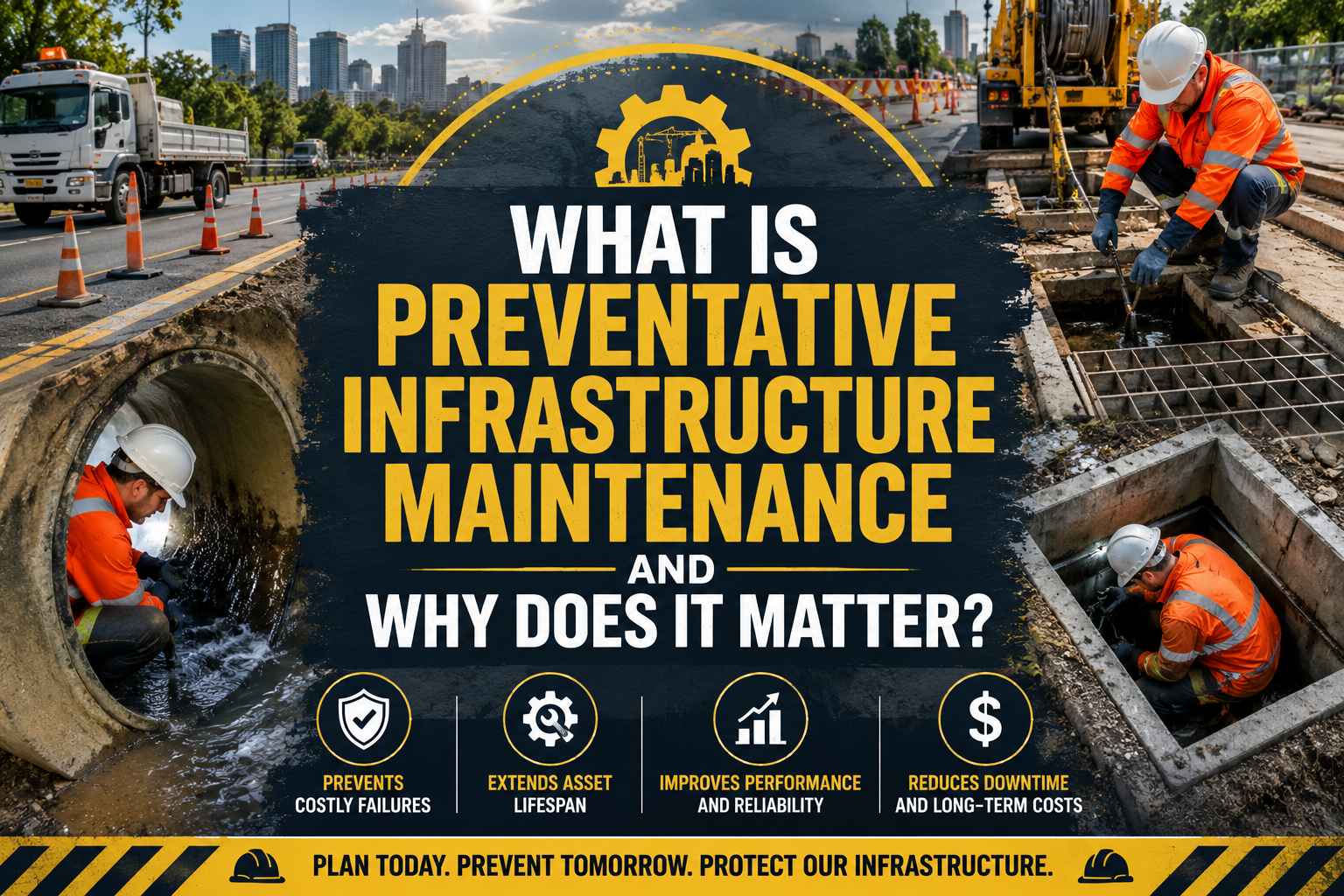
At its simplest, preventative infrastructure maintenance is the practice of routinely inspecting, servicing, and fixing small issues in civil assets before they turn into major structural failures. Think of it like getting the oil changed in your car.
You don’t wait for your engine to seize up in the middle of a busy highway before you check the dipstick; you service it every 5,000 miles so it keeps running smoothly. Applied to infrastructure maintenance on a grand scale, this proactive approach focuses on:
- Clearing stormwater drains before a heavy storm floods a commercial district.
- Monitoring concrete structures for moisture intrusion or early signs of rebar degradation.
- Sealing small hairline cracks in asphalt before winter freeze-thaw cycles turn them into massive potholes.
- Treating and recoating exposed steel on bridges to prevent rust and corrosion from eating away at structural integrity.
Rather than running assets to failure, preventative maintenance treats assets as long-term investments that need ongoing care.
Why is Preventative Maintenance Important for Civil Infrastructure?
Civil infrastructure maintenance isn’t just about keeping things looking nice; it forms the backbone of public safety, economic stability, and environmental health.
1. Public Safety First
- When civil structures fail, people get hurt. Compromised concrete on a multi-tier parking garage, unaddressed erosion around a bridge pier, or degraded airport runways pose immediate risks. Regular maintenance keeps these environments safe for everyday use.
2. Reliable Economic Flow
- Modern commerce relies on seamless logistics. If a key freight road, port terminal, or industrial park shuts down for unexpected emergency repairs, supply chains stall, businesses lose money, and commuters face hours of gridlock. Preventative maintenance allows work to be scheduled during off-peak hours, keeping traffic and business moving.
3. Maximising Asset Lifespan
- Bridges, roadways, and drainage systems are built to last decades, but only if they’re looked after. Neglect can cut the operational life of a civil asset in half, forcing local governments or commercial facility owners to spend millions on premature replacement.
How Does Preventative Maintenance Reduce Infrastructure Repair Costs?
There’s an old rule in civil engineering often referred to as the “Law of Fives.” Spent early on routine care, $1 of preventative maintenance saves $5 in minor repairs down the road, which in turn saves $25 in major rehabilitation, and up to $125 in total structural reconstruction.
- [ Routine Care ] –> $1
- [ Minor Repairs ] –> $5
- [ Major Rehab ] –> $25
- [ Reconstruction ] –> $125
Here is how proactive asset management keeps money in the bank:
- Eliminating Emergency Premiums: Emergency call-outs for crews, rush fees for materials, and overtime labour rates cost exponentially more than scheduled, non-urgent work.
- Budget Predictability: Routine maintenance creates smooth, predictable operational budgets year after year, avoiding sudden financial shocks to municipal or corporate balance sheets.
- Preventing Cascading Damage: An ignored leak in a concrete deck doesn’t stay isolated. Over time, water seeps through, corrodes structural steel, weakens load-bearing joints, and eventually destroys the entire slab. Fixing the seal costs hundreds; rebuilding the slab costs hundreds of thousands.
What Should an Infrastructure Maintenance Plan Include?
A solid asset management strategy isn’t built on guesswork; it relies on a structured, data-driven framework. A comprehensive infrastructure maintenance plan should always cover:
|
Key Component |
What It Covers |
|
Comprehensive Asset Inventory |
A complete register detailing every asset, its age, location, original materials, and service history. |
|
Condition Assessment Protocol |
Standardised rating scales to evaluate asset health consistently during every check. |
|
Scheduled Servicing Timelines |
Clear, recurring schedules for cleaning, sealing, joint repointing, and minor surface repairs. |
|
Risk & Criticality Prioritisation |
Matrix identifying which assets are most critical to operations or public safety if they fail. |
|
Budget & Resource Allocation |
Dedicated funding for both routine upkeep and contingency needs. |
Leading civil contracting specialists like Civilcraft emphasise whole-of-life asset modeling. By integrating condition assessments, engineered repair solutions, and ongoing scheduled maintenance right from the start, asset owners ensure their structures achieve maximum longevity with minimal operational disruption.
How Often Should Civil Infrastructure be Inspected?
Inspection schedules depend heavily on asset type, age, traffic load, and environmental exposure. However, a standard industry framework typically includes three main tiers:
- Routine Visual Walkthroughs (Daily to Monthly): Surface-level checks by maintenance personnel to spot obvious hazards like new potholes, damaged guardrails, or blocked storm drains.
- Periodic Detailed Inspections (Every 1 to 3 Years): Comprehensive evaluations using specialised tools to test surface wear, structural joints, waterproofing membranes, and concrete integrity. High-use environments like industrial parks, ports, and logistics hubs often require annual checks.
- In-Depth Structural & Non-Destructive Testing (Every 5 to 10 Years or Post-Event): Deep engineering assessments utilising advanced non-destructive testing (NDT), drone surveys, or ground-penetrating radar. These are also triggered immediately following extreme weather events like floods or earthquakes.
Also Read:- How to Prevent Asphalt Damage on High-Traffic Commercial Sites
Moving From Reactive Chaos to Proactive Care
Waiting for infrastructure to break before fixing it is a recipe for budget blowouts, safety risks, and operational chaos. By prioritising preventative infrastructure maintenance, communities and commercial facility operators protect their investments, keep people safe, and build resilient foundation systems that stand the test of time.
FAQs
Q:- What is preventative infrastructure maintenance?
Ans:- It is the practice of routinely inspecting and servicing civil assets to fix minor wear and tear before it escalates into major structural failure.
Q:- Why is preventative maintenance important for civil infrastructure?
Ans:- It keeps public roads and structures safe, prevents costly service disruptions, and significantly extends the total operational lifespan of critical assets.
Q:- What should an infrastructure maintenance plan include?
Ans:- A complete plan must feature a comprehensive asset inventory, standardised condition rating protocols, scheduled servicing timelines, risk prioritisation, and a clear maintenance budget.
Q:- How often should civil infrastructure be inspected?
Ans:- Inspection intervals range from daily visual walkthroughs for surface issues to 1–3-year periodic detailed checks, up to 5–10-year in-depth structural assessments or post-disaster evaluations.
Q:- How does preventative maintenance reduce infrastructure repair costs?
Ans:- It stops minor damage from causing widespread structural deterioration, allowing owners to avoid expensive emergency call-outs, overtime labour rates, and premature full reconstruction.