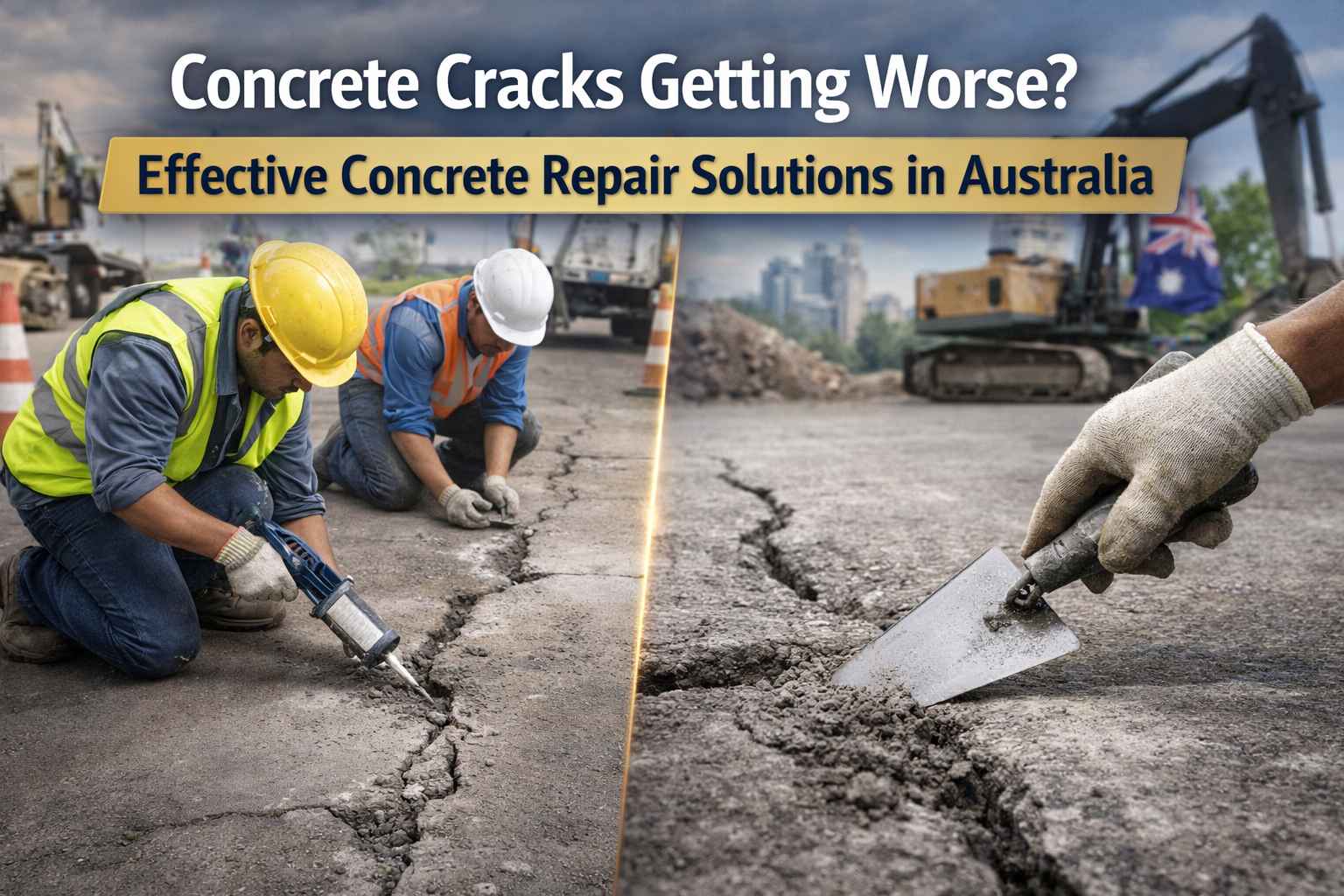
You’re walking down the driveway, or perhaps stepping out onto the back patio with a coffee, and you notice it: a thin, jagged line snaking across the concrete. At first, it’s barely a hairline. You think, “I’ll get to that eventually.”
But then, a few months of the harsh Australian sun go by, followed by a week of those sudden East Coast downpours, and suddenly that hairline fracture looks more like a miniature canyon.
Now, every time you drive the car over it, you hear a distinct thud, and you start wondering if your foundations are trying to tell you something. If you’re noticing concrete repair cracks on your property, you aren’t alone.
Between our “clay-heavy” soil and the wild temperature swings we get from Perth to Brisbane, concrete in Australia lives a hard life. But when do you actually need to worry, and what are the best ways to fix it before a small crack becomes a massive invoice?
Spotting the Danger: When is a Crack Just a Crack?

Not all cracks are created equal. If you want to avoid unnecessary panic, you need to know what you’re looking at.
-
The “Hairline” (Under 1mm)
These are usually “shrinkage cracks” from when the concrete was first poured. They are mostly aesthetic. You can usually DIY these with a simple sealer to prevent water ingress.
-
The “Step” Crack (Vertical Displacement)
This is when one side of the crack is higher than the other. It is a red flag. It means the ground has subsided or shifted unevenly. It creates significant safety risks, especially for elderly family members or kids running around, as it becomes a major trip hazard.
-
The “Wide Gap” (Over 5mm)
If you can fit a pencil inside the crack, it’s time to stop ignoring it. At this width, water is pouring directly into the sub-base, washing away the soil and making the structural damage worse with every rainfall.
Effective Concrete Repair Solutions for Aussies
The good news? You don’t always have to rip the whole thing up and start again. Modern tech has given us some pretty slick concrete repair cracks solutions that are faster and cheaper than a full replacement.
1. Epoxy & Polyurethane Injections
- For cracks in walls or structural pillars, professionals use high-pressure injections. Epoxy acts like a super-strong glue that actually restores the structural integrity of the concrete. Polyurethane, on the other hand, is great for stopping water leaks because it expands when it hits moisture.
2. Slab Jacking (Poly-Levelling)
- If your driveway has sunk on one side, you don’t need a new driveway; you need “Slab Jacking.” A technician drills small holes and injects a high-density foam underneath the slab. The foam expands, lifting the heavy concrete back to its original level.
3. Concrete Resurfacing
- If your concrete is covered in “spider-web” cracks but is still level, resurfacing is a brilliant cosmetic fix. A thin layer of polymer-modified concrete is spread over the top, giving you a brand-new finish (and a chance to change the colour or texture!) without the cost of a full pour.
Why “Wait and See” is a Bad Strategy
I get it, home maintenance is expensive and boring. But with concrete, the “ignore it” tax is incredibly high. Leaving concrete repair cracks unaddressed leads to:
- Concrete Cancer: As mentioned, once the internal steel starts rusting, the repair costs jump from hundreds to thousands.
- Property Value: Nothing screams “this house hasn’t been looked after” like a crumbling driveway. It’s the first thing potential buyers see.
- Safety Risks: If a delivery driver or a neighbour trips on a displaced slab on your property, you’re looking at a much bigger headache than a repair bill.
DIY vs Professional: Where to Draw the Line?
If you’ve got a small crack on a flat patio, a tube of high-quality concrete filler from the local hardware store and a sunny afternoon will do the trick. Just make sure you clean the crack thoroughly first; any dirt or loose pebbles will prevent the filler from bonding.
However, if the crack is wider than a 10-cent piece, if one side is higher than the other, or if it’s near a supporting wall, call in a specialist from Civilcraft. Dealing with such damage requires an understanding of load-bearing weights that a YouTube tutorial just can’t provide.
Also Read:- Struggling with Site Waste? Waste Management Services in Australia That Actually Work
Conclusion: Take Action Before the Next Storm
In Australia, our homes have to be as tough as the landscape. Concrete is the literal foundation of that toughness, but it needs a little love every now and then.
By catching those cracks early and using the right concrete repair cracks methods, you save your wallet and your shins from future pain. Keep an eye on those lines. If they start growing, it’s time to act. Your future self (and your car’s suspension) will thank you.
FAQs
Q:- Can I just pour new concrete over old cracks?
Ans:- No. If the old concrete is still moving or sinking, the new layer will simply crack in the exact same spot within a few weeks. You must stabilise the base first.
Q:- Is “Concrete Cancer” actually fixable?
Ans:- Yes, but it’s a surgical process. A pro has to chip away the bad concrete, treat or replace the rusted steel, and then patch it with specialised mortar.
Q:- Does home insurance cover concrete cracks?
Ans:- Usually, no. Most policies view concrete cracking as “wear and tear” or “ground movement,” which are typically excluded unless it’s caused by a specific event like a burst pipe.
Q:- How long do concrete repairs last?
Ans:- A professional epoxy or resin repair can last 10–20 years, provided the underlying soil issue (like a leaking pipe or a thirsty tree root) has been solved.
Q:- Is a cracked driveway a safety risk?
Ans:- Absolutely. Beyond the trip hazard, large cracks can damage tyres and, in extreme cases, indicate that the ground is washing away near your home’s actual foundation.