
Have you ever pulled into a commercial parking lot on a dark, rainy evening, only to realise the painted lines have completely vanished? Suddenly, parking becomes a stressful game of guesswork. You find yourself wondering, Am I occupying two spaces? Is this a one-way lane? Where exactly is the pedestrian walkway?
It’s easy to take the bright yellow and white lines on our asphalt for granted, but they are truly the unsung heroes of daily public safety. Whether we are navigating a tight commercial bay or cruising down a multi-lane highway, high-visibility boundaries keep chaos at bay.
Maintaining crisp, clear lines isn’t just about making a property look neat; it’s a critical infrastructure requirement. Let’s dive into the fascinating world of professional line marking services and explore how proper markings protect lives, optimise space, and keep traffic moving smoothly in 2026.
Why Are Parking Lot Markings Fading Quickly?
It’s a common frustration for property managers: you invest in a fresh paint job, and within what feels like no time at all, the lines look dull, chipped, and weathered. Why does this happen? The rapid deterioration of car park line marking layouts usually comes down to three main culprits:
- High-Friction Tyre Scrubbing:
Unlike long stretches of open highway where vehicles travel in straight lines, parking lots are high-stress environments for paint. Cars are constantly turning their wheels while stationary, braking sharply, and executing tight maneuvers. It creates intense mechanical friction that literally scrapes the paint right off the surface.
- The Harsh Elements:
UV radiation from intense sunlight breaks down the chemical binders in standard paints, causing them to turn brittle and chalky. When you combine UV exposure with pooling rainwater and fluctuating temperatures, the paint expands and contracts until it cracks and flakes away.
- Poor Surface Preparation:
If a contractor sprays fresh paint directly over oil stains, loose dirt, or old, peeling layers, the new coating won’t bond properly to the asphalt. Within a few months, the entire layer will simply lift off due to poor line marking services.
What Type of Paint is Used for Road Line Marking?
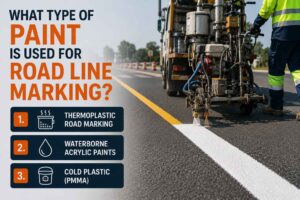
You can’t just head down to the local hardware store, grab a few cans of exterior acrylic, and expect it to survive a heavy flow of semi-trucks. Modern road marking services rely on highly sophisticated chemical compounds engineered to withstand immense weight and brutal weather conditions. The industry relies heavily on three primary categories of material:
1. Thermoplastic Road Marking
- It is the gold standard for high-traffic public roads. Thermoplastic is a dry block or powder mixture of synthetic resins, pigments, and glass beads.
- The material is heated to roughly 200°C until it melts into a thick liquid, which is then extruded onto the pavement. As it cools, it forms a rock-hard, thick plastic bond with the road surface that can endure heavy traffic for years.
2. Waterborne Acrylic Paints
- Commonly used for neighborhood streets and indoor or outdoor warehouse layouts, these fast-drying, water-based paints are highly eco-friendly. They offer excellent visibility and crisp edges, making them a cost-effective choice for environments that don’t experience heavy highway wear.
3. Cold Plastic (PMMA)
- This ultra-durable two-part chemical compound is applied cold but cures incredibly quickly via a chemical reaction. It is primarily reserved for extreme wear zones, such as heavily trafficked pedestrian crossings, bicycle lanes, and high-speed intersections.
The Secret Ingredient: Ever wonder why road lines glow so brightly under your headlights at night? Professional crews drop tiny, retroreflective glass beads directly into the wet paint during application. These microscopic spheres bounce the light from your headlights straight back to your eyes, keeping drivers safe in the dark.
How Clear Markings Revolutionise Traffic Flow and Safety
When a layout is professionally designed and strictly maintained, it does much more than provide a place to park; it actively choreographs human behaviour.
- Maximised Real Estate:- A poorly marked lot leads to lazy, unorganised parking. Clear, bright stalls maximise your space, allowing you to fit up to 30% more vehicles safely into the same footprint.
- Defensive Pedestrian Protection:- Clearly designated zebra crossings, shared-zone symbols, and pedestrian walkways establish explicit right-of-way zones, keeping vulnerable walkers completely separated from moving vehicles.
- Reduced Liability and Accidents:- If an accident occurs on a commercial property where the directional arrows and stop lines have completely faded away, the property owner can face legal liability. Clear markings establish unambiguous rules of the road.
How Long Does Line Marking Paint Last?
There is no single expiration date for painted lines because their durability depends entirely on traffic volume, material quality, and climate conditions. To give you a general idea of what to expect, let’s look at how the different materials compare under typical operational conditions:-

Engineering Precision with Civilcraft
When dealing with large-scale commercial properties, municipal roads, or heavy industrial facilities, you cannot afford to work with amateur contractors. Achieving straight, durable, and fully compliant lines requires deep structural knowledge of line marking services and professional civil engineering expertise.
This is exactly where a tier-one infrastructure specialist like Civilcraft excels. Known for delivering comprehensive civil construction, concrete works, and asphalt maintenance, Civilcraft understands that line application is the crucial final step of any major infrastructure project.
By pairing cutting-edge application technology with meticulous surface preparation and premium-grade materials, we ensure that your traffic lanes, directional symbols, and specialised zones remain highly visible and fully compliant with strict safety standards for years to come.
Also Read:-Asphalt Repair and Maintenance: How to Extend the Life of Roads and Driveways
Conclusion
Ultimately, investing in professional line marking services is the smartest way to transform a chaotic pavement into a highly efficient, safe, and organised space. Don’t let faded paint compromise your property’s safety; give your asphalt the crisp, high-visibility boundaries it needs to keep everyone moving smoothly.
FAQs
Q. How often should line markings be refreshed?
For standard commercial properties and busy car parks, lines should typically be refreshed every 12 to 24 months to maintain maximum visibility, safety compliance, and aesthetic appeal.
Q. How long does it take for fresh line paint to dry before cars can drive over it?
Modern water-based traffic paints dry to the touch in about 15 to 30 minutes, but it is highly recommended to keep vehicles off the fresh lines for at least 1 to 2 hours to allow them to cure fully.
Q. Can line marking services be applied over damp asphalt?
No. Applying paint to a wet surface traps moisture underneath, preventing the compound from bonding with the substrate and causing the paint to bubble, crack, and peel off almost immediately.
Q. What is the difference between line painting and line removal?
Line painting applies new boundaries, while line removal utilises specialised techniques like ultra-high-pressure water blasting or mechanical grinding to erase old, incorrect, or outdated layouts completely without destroying the underlying pavement.
Q. Why are yellow lines used instead of white lines in certain areas?
White lines are typically used to delineate traffic moving in the same direction or to mark standard parking bays. In contrast, bright yellow lines are universally reserved for high-caution areas, such as loading zones, no-parking zones, clearways, and pedestrian safety boundaries.