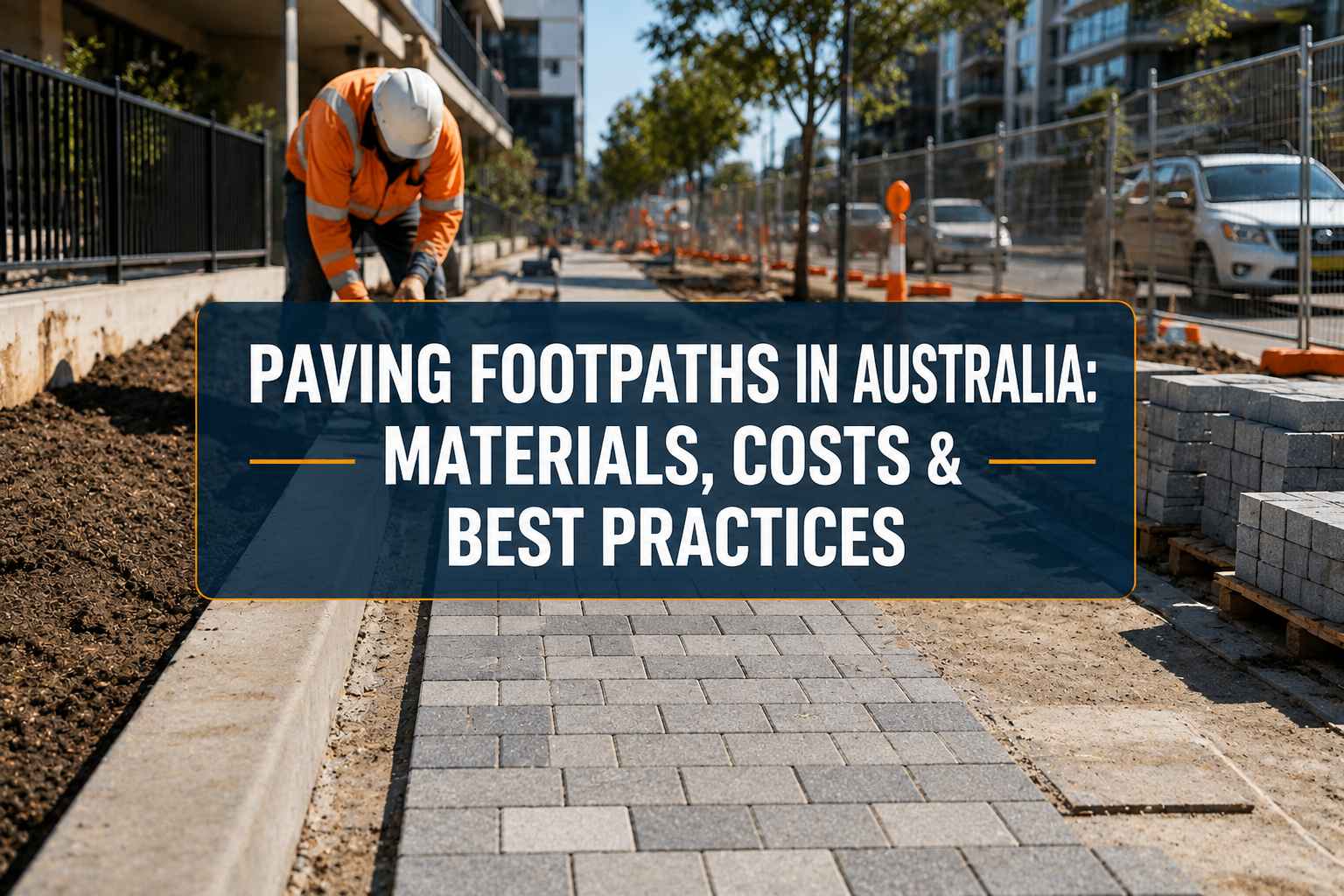
When you walk down a smoothly paved suburban street or a bustling commercial strip, you probably don’t think twice about the ground beneath your feet. But behind every flawless walkway is a delicate balance of engineering, material science, and strict compliance.
Paving footpaths across Australia isn’t just about throwing down some bricks or pouring a bit of mix; it’s about building safe, accessible, and highly durable community infrastructure that can withstand everything from scorching summer heatwaves to heavy downpours.
Whether you’re a property developer managing a new subdivision or a local council member overseeing community assets, getting your footpath strategy right saves immense time and taxpayer money down the line. Let’s look at what goes into building top-tier walkways, how much it really costs, and what it takes to keep them in peak condition.
What is the Best Material for Paving Footpaths in Australia?

There isn’t a single “perfect” material, as the ideal choice depends completely on the path’s intended traffic level, aesthetic goals, and environment. However, three main materials dominate Aussie infrastructure:
- Asphalt (Bitumen): An excellent choice for long, winding shared-user paths or parklands where a seamless, cost-effective, and rapidly laid surface is needed to accommodate both pedestrians and cyclists.
- Cast-in-Situ Concrete: It is the undisputed heavyweight champion for standard suburban paths. It creates a continuous, incredibly flat surface that eliminates trip hazards. When given a textured brush finish, it provides exceptional slip resistance during winter rains.
- Interlocking Concrete or Clay Pavers: Highly favoured in urban plazas, shopping strips, and heritage areas. Pavers offer beautiful design versatility and are structurally excellent because they allow for slight soil movement without cracking. Plus, if underground utility pipes burst, workers can lift individual pavers out and replace them without leaving behind ugly, patched-up scars.
What are the Australian Standards for Footpath Construction?
You can’t just pave a path however you see fit; public infrastructure must meet rigorous civil guidelines to ensure universal accessibility. The most important benchmark is AS 1428 (Design for Access and Mobility).
This standard mandates that paths must be fully accessible to everyone, including parents pushing prams, older adults, and individuals using wheelchairs or mobility scooters. Under these guidelines, a standard residential footpath requires a minimum clear width of 1,200mm, while commercial or high-traffic zones often push past 2,000mm.
Furthermore, the crossfall (the side-to-side slope designed to shed water) must be incredibly gentle, strictly capped at a maximum gradient of 1 in 40 (2.5%) to prevent wheelchairs from veering off into the nature strip.
Designers must also integrate Tactile Ground Surface Indicators (TGSIs)—those textured, bumpy tiles—near kerb ramps and street intersections to guide visually impaired community members safely.
How Much Does Footpath Paving Cost Per Square Metre?
On average, commercial and council-grade footpath construction in Australia ranges between $75 and $170 per square metre, factoring in both materials and professional labour. A straightforward, plain concrete or asphalt path on level ground sits on the lower end of the spectrum.
In contrast, coloured concrete, exposed aggregate, or premium interlocking brick pavers pushing intricate patterns sit on the higher end. Keep in mind that these rates fluctuate based on how much excavation, leveling, and drainage preparation is required before the actual surface can be laid down.
How Long Does A Paved Footpath Last?
When engineered properly from the subgrade up, a high-quality civil footpath boasts an impressive lifespan:
- Concrete Paths: Easily last 30 to 40+ years before requiring major reconstruction.
- Asphalt Walkways: Generally offer a lifespan of 15 to 20 years before requiring a fresh resurfacing layer.
- Interlocking Pavers: Can endure for 25 to 30 years, though individual blocks may need minor realignments over time due to invasive tree roots.
What Maintenance is Required for Paved Footpaths?
To achieve those decades of service, proactive maintenance is essential. The primary requirement is regular structural inspections to identify step hazards or cracks caused by shifting soils and tree roots. For paved paths, joint sand needs to be replenished periodically to keep the interlocking blocks from shifting out of place.
Applying industrial sealants every few years protects against oil stains and water ingress. At the same time, routine power washing removes slick moss, grime, and debris that could create dangerous slipping hazards for pedestrians.
Also Read:- Sandstone Block Walls in Australia: Benefits, Construction & Maintenance Guide
Engineering Precision with Civilcraft
Navigating council approvals, compliance, and heavy machinery is a massive undertaking while paving footpaths. That is exactly where civil construction specialists like Civilcraft step in to make the entire process effortless.
Civilcraft brings decades of specialised civil engineering expertise to the table, handling everything from large-scale municipal footpath rollouts to complex urban plaza designs. Our teams manage the entire lifecycle of a project—executing precise site excavation, installing robust drainage solutions, and laying down compliant surfaces.
By partnering with a dedicated team that understands the micro-details of local council specifications and strict civil compliance, you guarantee a durable, stress-free build that safely connects communities for generations.
FAQs
Q:- What is the minimum legal width for a public footpath in Australia?
Ans:- Under Austroads and AS 1428 guidelines, the standard minimum clear width for a residential footpath is 1,200mm, allowing enough room for a pedestrian and a pram to pass comfortably. High-traffic commercial zones require 2,000mm or more.
Q:- Why do concrete footpaths have lines cut into them every few metres?
Ans:- Those are control joints (usually spaced at 1.5-metre intervals). Concrete naturally expands and contracts with shifting temperatures; these deliberate grooves encourage the concrete to crack cleanly in a hidden, straight line rather than fracturing randomly across the surface.
Q:- Can tree roots ruin a paved footpath?
Ans:- Yes, tree roots are a primary cause of path lifting and cracking. Civil constructors manage this by installing specialised, underground root barriers during construction to redirect root growth straight downward, safely away from the pavement base.
Q:- What happens if a built footpath fails a council crossfall inspection?
Ans:- If a path exceeds the maximum 1 in 40 crossfall gradient, it violates accessibility codes and creates a tipping hazard for wheelchairs. In most municipal contracts, non-compliant sections must be completely demolished and repoured at the contractor’s expense.
Q:- Is permeable paving allowed for civil footpaths in Australia?
Ans:- Yes! Many forward-thinking councils are actively adopting permeable paving systems. These eco-friendly blocks allow rainwater to filter directly through the surface into the natural water table below, reducing stormwater runoff and taking pressure off city drainage infrastructure.