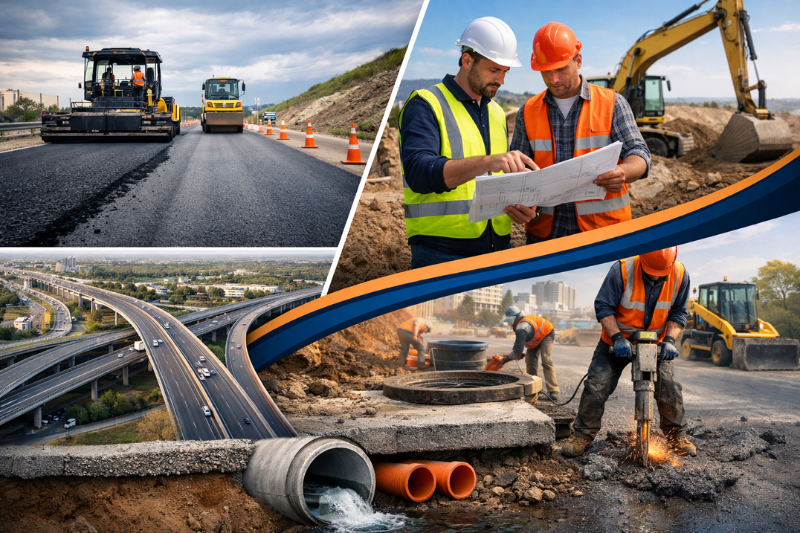
When you hear “roadworks case studies”, you might imagine cones and delays. But peel back the layers and what you really find are stories about problem-solving, coordination, engineering know-how, and tangible improvements to everyday infrastructure.
That’s where Civilcraft’s work shines — real-world results, not just theory. In this article, we’ll walk through a set of Roadworks Case Studies by Civilcraft, breaking down what they did, why it mattered, and what you can learn from each one. We’ll keep it clear and practical.
What “Roadworks Case Studies” Actually Tell Us
Case studies aren’t just project summaries. They’re snapshots of challenges faced on a site, choices the team made, and the impact those choices had on communities, assets, safety and long-term performance.
Civilcraft’s roadworks portfolio spans from internal site access upgrades to high-impact public projects like road reconstructions and pedestrian safety improvements. These are not cookie-cutter jobs; each one has its own unique context, constraints and outcomes.
Case Study 1: Internal Roadways & Infrastructure Upgrade
This one might sound boring at first: an internal roadway. But think of it like the circulatory system of a site, when the internal roads don’t work well, everything else grinds to a halt.
- Civilcraft was brought in to renovate and improve both the pavement and supporting infrastructure. The focus was on delivering a durable surface and improving drainage.
- That kind of work matters more than most people realise, because poor drainage and weak pavement can lead to rapid deterioration and costly repairs down the line.
What it really highlights is that Civilcraft doesn’t just pour asphalt — they look at how the surrounding infrastructure (like drainage and grading) supports the road’s performance.
Case Study 2: Blaxland Road, Denistone Civil Works
Think of this as an example of upgrading community roads. Here, Civilcraft wasn’t dealing with a private yard; they were improving a public thoroughfare used every day by local traffic.
- In situations like this, the challenge isn’t just the construction itself; it’s managing traffic flow and minimising inconvenience. Designing work that keeps vehicles moving while crews carry out civil works takes patience and a well-planned approach.
- What this project shows is that good roadworks aren’t just technical, they’re considerate of the people who use those roads every day.
Also Read – Concrete Restoration: Best Techniques for Long-Lasting Structural Repair
Case Study 3: Water Street Pavement Reconstruction
Now we’re talking a full reconstruction, not just a patch-up. On Water Street, Civilcraft took a deteriorating roadway and transformed it into a resilient surface complete with drainage infrastructure and improved crossings.
- Projects like these are about long-term thinking. Instead of spending money on frequent fixes, Civilcraft rebuilt the foundation, addressed subsurface issues, and gave the whole street a new lease on life.
- For council planners and asset owners, that’s a much smarter investment. It is a common theme in Roadworks Case Studies — solve the root problem, not just the symptoms.
Case Study 4: Lane Cove Tunnel Retaining Wall
Sometimes the roadwork isn’t on the road itself; it’s on the structures that support it. In this project, Civilcraft was involved in the demolition and reconstruction of a block retaining wall at the Lane Cove Tunnel.
- What’s key here is structural reliability. Retaining walls aren’t glamorous, but they’re essential for preventing collapses, maintaining safe embankments, and protecting motorists and pedestrians.
- It’s a reminder that road infrastructure is about systems — pavement layers, barriers, retaining walls and the soil and water around them. Every component needs attention.
Case Study 5: Pedestrian Safety Upgrade
At Botany Bay Council, the focus was on pedestrian safety. Upgrading road environments for pedestrian use might mean new footpaths, better crossings, or reshaping traffic lanes so that people walking feel safer. These changes don’t just improve comfort; they reduce accidents.
Roadworks aren’t just about cars and trucks. They’re about the people who walk, cycle and live beside those roads. And treating pedestrian upgrades as part of roadworks shows a holistic approach to infrastructure that puts safety first.
What You Learn From These Roadworks Case Studies

Across these projects, some themes become clear:
- Every project is different
An internal access road isn’t the same as a public street, and reconstruction isn’t the same as safety upgrades. Each project demands its own strategy.
- Engineering fundamentals still rule
Strong foundations, good drainage, and appropriate materials- these basics matter whether the road is a private driveway or a busy council street.
- Long-term value outweighs short-term fixes
Comprehensive reconstructions and infrastructure upgrades mean lower maintenance costs and longer service life — plain and simple.
- User-centric roadworks make a difference
Whether it’s pedestrians or local drivers, thinking about how people experience the road is what separates a good job from a great one.
- Planning keeps projects efficient
Minimising disruption, staging work smartly, and adhering to safety standards all ensure projects don’t just finish, but finish well.
Also Read – The Benefits of Using Asphalt Recyclers in Construction and Maintenance
A Practical Takeaway for Civil Infrastructure Planners
If you’re overseeing public assets or coordinating upgrades, these case studies serve as templates. They highlight the importance of:
- Making choices that prioritise durability over short-term savings
- Assessing underlying conditions before deciding on fixes
- Designing with both performance and safety in mind
- Communicating clearly with stakeholders and users
Roadwork isn’t just laying asphalt. It’s aligning engineering, logistics, safety and public needs into an outcome that lasts. That’s what these Roadworks Case Studies make clear.
FAQs
Q:- What does “roadworks” actually include?
Ans:- Roadworks cover everything from pavement repair and reconstruction to safety upgrades, drainage improvements, and structural installations that support roads.
Q:- Why use case studies when planning infrastructure?
Ans:- Case studies show real examples of problems and solutions in action. They help planners understand what works and why, saving time and reducing guesswork.
Q:- How does Civilcraft approach roadwork planning?
Ans:- They focus first on engineering fundamentals, user needs, safety and efficient project execution. That means careful planning and appropriate materials and methods.
Q:- Do these projects consider traffic disruption?
Ans:- Yes. Good roadworks planning includes scheduling, traffic management, and staging to keep disruption as low as possible.
Q:- Can these case studies be adapted for other regions?
Ans:- Absolutely. The principles — assess the problem, design for longevity, manage safety and traffic — are universal in civil infrastructure.