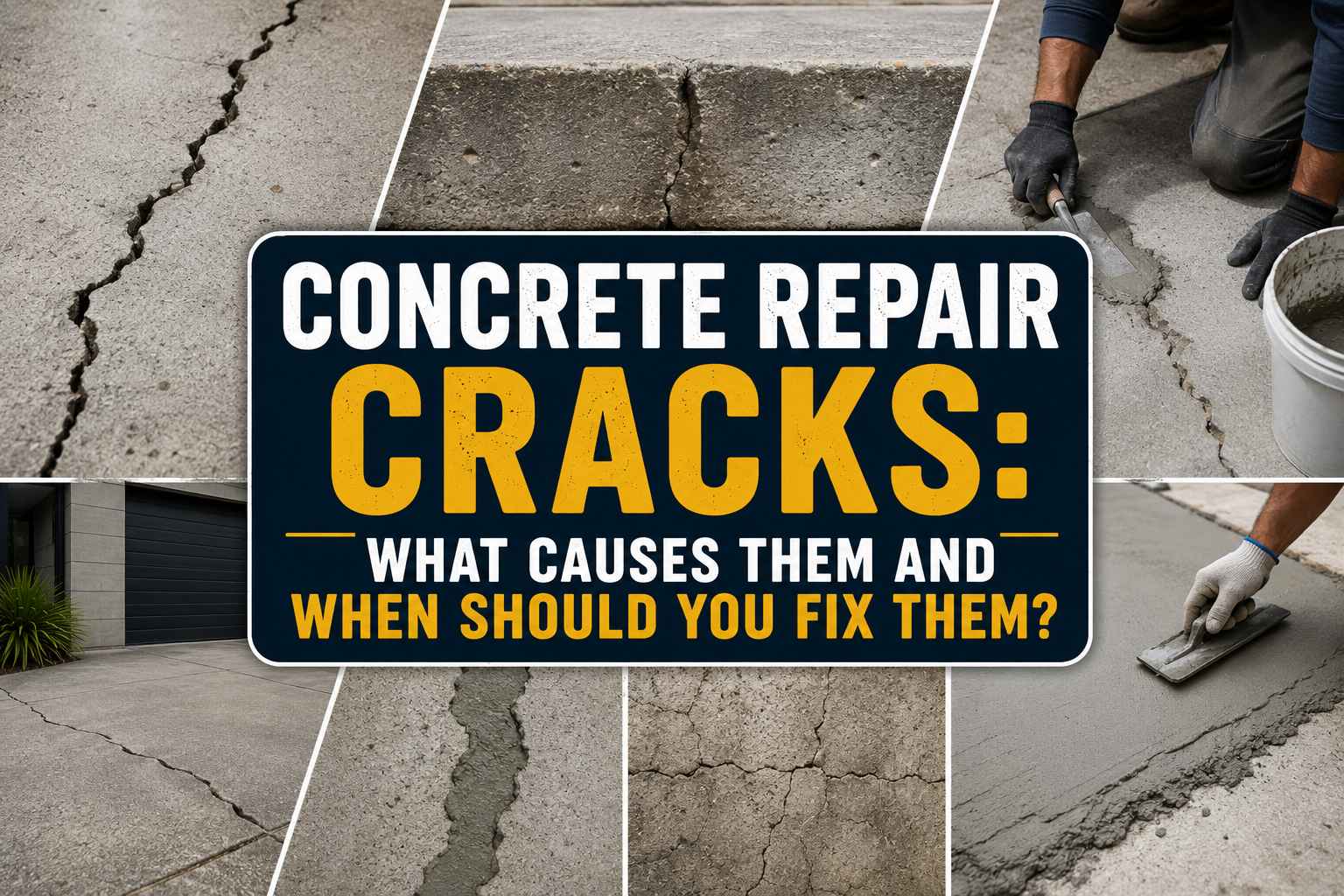
Whether it’s a hairline fracture running across your backyard patio, a widening gap in your driveway, or uneven settlement on a commercial warehouse floor, dealing with concrete repair cracks is practically a rite of passage for property owners down under.
Australia’s extreme climate isn’t particularly kind to concrete structures. Between reactive clay soils that swell and shrink like a sponge, blazing summer heat, and torrential seasonal storms, our slabs are constantly under tension.
But how do you know when a minor surface flaw is just cosmetic and when it’s an early warning sign of structural failure? Ignoring a crack rarely works out well in the long run.
Here is a practical guide to spotting troublesome cracks early, understanding what causes them, and choosing the right repair methods before a small fix turns into a massive expense.
Why Australian Concrete Is Uniquely Vulnerable
Concrete seems indestructible when it’s poured, but it is actually a porous material that relies on balanced internal moisture and stable subsoil support. Australia’s unique climate creates a perfect storm for structural stress:
- Reactive Soils: Much of suburban Australia sits on expansive clay soils. When it rains, the clay expands and pushes up against slabs. During dry spells, the soil shrinks away, leaving hollow voids beneath your driveway or foundation.
- Thermal Expansion: Large daily temperature swings cause concrete to expand during the hot afternoon sun and contract at night. Without proper expansion joints, this movement forces the slab to crack under its own pressure.
- Coastal Environments: For properties near the coast, salt-laden air penetrates porous concrete and corrodes the internal steel reinforcing mesh. As the steel rusts, it expands up to six times its original volume, bursting the concrete from the inside out.
The Telltale Signs: How to Inspect Your Slabs
Not every crack requires a full engineering team, but you do need to know what you’re looking at. Taking a few minutes to inspect the depth, shape, and height difference across a crack will tell you everything you need to know.
|
Crack Type |
Visual Characteristics |
Potential Cause |
Recommended Action |
|
Plastic Shrinkage |
Very thin, shallow, usually less than 1mm wide. Appears soon after pouring. |
Rapid drying during installation. |
Apply a high-quality concrete sealer to keep out moisture. |
|
Active Settlement |
2mm to 5mm wide, slowly expanding over months or seasons. |
Soil movement or sub-base wash-out. |
Route out the crack and fill with flexible polyurethane sealant. |
|
Heaving / Step Cracks |
One side of the crack is visibly higher than the other, creating a trip hazard. | Severe tree root intrusion or reactive soil heave. |
Leveling via slab grinding or high-density resin injection. |
|
Structural / Spalling |
Wider than 6mm, deep, with flaking edges or rust stains. | Internal rebar corrosion or heavy load overload. |
Requires professional structural intervention immediately. |
When Can You Delay, and When Must You Act?
A common question property owners ask is: “Can I just leave this until next summer?” If you have a dry, indoor garage floor with a minor surface shrinkage line, you usually have time on your side.
However, if the crack is outdoors and exposed to rain, delaying is a gamble. Water is the absolute enemy of concrete structures.
Once water gets inside a crack, it works its way down to the underlying dirt base, washing away the compacted sand and gravel that holds up the weight. Once that base collapses, the slab drops, and what was a simple sealing job turns into a costly excavation project.
Furthermore, if your concrete carries vehicle traffic, like a commercial loading zone, a driveway, or a car park, the dynamic weight of tyres continually flexes the edges of the crack, crumbling the sides and widening the gap day by day.
How Civilcraft Can Help
When a crack moves past a basic weekend DIY patch and starts threatening the integrity of your property, bringing in seasoned civil engineering expertise is the safest and most cost-effective move. This is where Civilcraft comes in.
Specialising in civil construction, structural remediation, concrete repair cracks and public infrastructure maintenance across Australia, Civilcraft delivers engineered solutions tailored to complex concrete challenges.
Rather than simply applying a quick surface skim that flakes off after the first rainstorm, Civilcraft’s specialist teams take a diagnostic approach, identifying the root cause of the failure, whether it’s sub-base erosion or heavy load fatigue. Our comprehensive services include:
- Trip Hazard Mitigation & Grinding: Precision grinding to level out offset slabs and ensure public safety compliance.
- Full Asset Rehabilitation: Comprehensive repairs for industrial floors, bridge decks, and heavy commercial pavements.
- Flexible Joint Systems: Installing semi-rigid epoxy and elastomeric sealants that accommodate natural thermal expansion without failing.
- Structural Epoxy Injection: High-pressure injection techniques that restore structural strength by welding deep internal fractures back together.
By partnering with Civilcraft, asset managers and property owners ensure their concrete infrastructure meets Australian standards while maximising service life and minimising costly operational downtime.
Also Read:- Concrete Repair Cracks: When Should You Resurface Instead of Replace in Sydney?
FAQs
Q:- What causes cracks in concrete?
Ans:- Cracks typically form due to initial drying shrinkage, ground movement or soil subsidence, heavy traffic loading, poor drainage washing away the sub-base, or natural expansion and contraction caused by extreme heat.
Q:- Can small concrete cracks become serious?
Ans:-Yes. Even minor hairline cracks allow rain and groundwater to seep into the sub-base, washing away supporting soil or rusting internal steel rebar, which eventually causes spalling, uneven sinking, and major structural faults.
Q:- What is the best method for concrete crack repair?
Ans:- The best method depends on the crack type: high-pressure epoxy injection works best for structural strength, expanding polyurethane foam excels at stopping active water leaks, and flexible polyurea/polyurethane sealants work best for moving joints.
Q:- How much does concrete crack repair cost?
Ans:- Costs vary significantly based on crack depth, length, accessibility, and the chosen method. A simple DIY sealant kit may cost under $50, whereas professional resin injection, slab-jacking, or commercial structural remediation ranges higher based on complexity.
Q:- Should I repair concrete cracks or replace the slab?
Ans:- If the slab is structurally sound and relatively level, repairing or resurfacing it is vastly cheaper and faster than pouring fresh material. Full replacement is generally only necessary when the concrete has shattered into multiple unlevel pieces or experienced complete sub-base failure.