
We’ve all been there: driving home late at night on a dark, rain-slicked road. The only thing keeping you from drifting into a ditch or, worse, into oncoming traffic is those bright, reflective lines guiding your way.
We see them every single day—yellow lines, white dashes, solid borders, and painted arrows—but how often do we actually stop to think about them? Road markings are like the “UI” (User Interface) of the physical world.
Without them, our roads would be nothing short of a demolition derby. From the humble parking lot to the busiest twelve-lane highway, line marking services are what keep civilisation moving in an orderly fashion. So, let’s take a deep dive into the world of road lines.
What is Line Marking?
Line marking is the process of applying visible lines, symbols, and markings on roads, car parks, warehouses, and public spaces to improve safety, traffic flow, and organisation. It is commonly used for:
- Road lane markings
- Car park line marking
- Pedestrian crossings
- Warehouse safety zones
- Sports courts and playgrounds
Professional line marking helps increase visibility, safety, and compliance in both commercial and public areas.
More Than Just “Paint on the Ground”
The first thing people usually assume is that road marking is just a guy with a bucket of white paint and a brush. If only it were that simple! In reality, the “paint” used by professional line marking services is a high-tech cocktail of chemicals designed to survive incredible abuse.
These lines have to endure thousands of tons of heavy trucks grinding over them, 24/7 exposure to scorching UV rays, freezing snow, and torrential rain. If you used regular house paint, it would be gone after the first Tuesday morning rush hour.
Modern road markings are often made from thermoplastic. It is a solid material that gets heated up to about 200°C until it’s a liquid, then it’s “extruded” onto the road. As it cools, it bonds physically and chemically to the bitumen. It’s thick, tough, and lasts for years.
Why Do We Even Need Line Marking Services?
It sounds obvious, right? “To show us where to go.” But it goes deeper than that. Line marking is a sophisticated language that tells a story without using a single word.
- Pedestrian Protection:- Zebra crossings and “Look Left/Right” markings are the only things standing between a 2-ton car and a person walking to get a bagel.
- Night Vision:- Professional line marking services drop tiny, microscopic glass beads into the wet paint or thermoplastic. These beads act like retroreflectors, bouncing the light from your headlights directly back to your eyes.
- Defining Boundaries:- The most basic job is separating traffic. Whether it’s a double yellow line telling you “don’t even think about passing” or a dashed white line saying “go ahead, but be careful,” these markings prevent head-on collisions.
The Different Types of Line Marking in 2026
If you start paying attention, you’ll realise there’s a whole library of different markings out there. Here are the heavy hitters:
1. Transverse Lines
- These run across the road. Think stop lines at intersections or the “give way” triangles. These are crucial because they tell a driver exactly where their legal responsibility to stop begins.
2. Longitudinal Lines
- These are the ones that run parallel to the traffic. They tell you where your lane starts and ends. In many countries, white lines separate traffic moving in the same direction, while yellow (or sometimes double white) lines separate traffic moving in opposite directions.
3. Symbols and Legends
- This is the “shorthand” of the road. High-occupancy vehicle (HOV) diamonds, bicycle symbols, and those giant “BUS ONLY” letters are all part of the ecosystem. These require precision stencilling to ensure they are legible even when you’re zooming past at 60 mph.
The Business Side: Commercial Line Marking
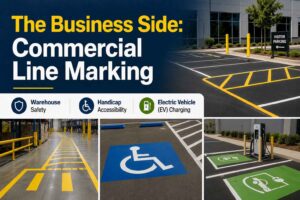
It’s not just the government that needs line marking services. If you own a business, your parking lot is the first thing a customer sees.
A parking lot with faded, confusing lines screams “I don’t care about maintenance,” whereas crisp, bright lines make a place feel safe and professional. Businesses use line marking for:
- Warehouse Safety:- In industrial hubs, lines on the floor designate “pedestrian-only” zones versus “forklift-only” zones. In a loud warehouse, you might not hear a forklift coming, but you can definitely see the bright yellow line you aren’t supposed to cross.
- Handicap Accessibility:- Ensuring that ADA-compliant (or local equivalent) parking spaces are clearly marked isn’t just a nice thing to do—it’s a legal requirement.
- Electric Vehicle (EV) Charging:- With the rise of EVs, we’re seeing a massive surge in the need for green-painted bays and charging symbols.
The Future of the Line Marking
- Believe it or not, the “smart road” revolution is coming. With the rise of self-driving cars, line marking is more important than ever. Those cameras and “Lidar” sensors on a Tesla or a Waymo rely heavily on clear, high-contrast lines to stay in their lanes.
- We’re even seeing experiments with “glow-in-the-dark” photo-luminescent paint that charges during the day and glows at night without needing electricity. The humble white line is going high-tech!
Environmental Considerations
- The industry has changed a lot lately. In the old days, road paint was full of “VOCs” (volatile organic compounds) that weren’t great for the people breathing them in or for the atmosphere.
- Today, many line marking services use water-based paints or high-solids coatings that are much “greener” but still just as tough.
Also Read:- How to Repair Bitumen Driveway | Guide 2026
Conclusion
Next time you’re driving, take a second to appreciate those lines. They are the silent conductors of the world’s most complex orchestra.
Whether it’s a fresh coat on a new highway or a re-striping of a local grocery store lot, quality line marking services are the backbone of organised transit. Stay between the lines, stay safe, and appreciate the paint!
FAQs
Q:- What is line marking?
Ans:- Line marking is the process of applying durable painted or thermoplastic lines and symbols to surfaces such as roads, car parks, warehouses, factories, and sports courts. These markings help direct traffic, improve safety, organise spaces, and ensure compliance with Australian standards.
Q:- How long does it take for road paint to dry?
Ans:- Modern water-based road paint is “track-free” (meaning you can drive over it without smearing) in about 2-5 minutes. Thermoplastic cools and sets instantly, usually within 60 seconds.
Q:- Why are some lines yellow and others white?
Ans:- It varies by country, but generally, white lines separate traffic moving in the same direction, while yellow lines indicate the “edge” of the opposing traffic flow or “no parking” zones.
Q:- What are those bumps on the lines?
Ans:- Those are called “rumble strips” or “raised pavement markers.” They are designed to vibrate your car or make a noise to wake you up if you’re accidentally drifting out of your lane.
Q:- Can you do line marking on wet roads?
Ans:- No. Just like bitumen repair, the paint won’t bond to a wet surface. It will end up peeling off in big sheets like a bad sunburn.
Q:- How often do roads need to be re-marked?
Ans:- High-traffic highways might need a refresh every 1-2 years, while a quiet parking lot can often go 3-5 years before the lines become too faded to see clearly.