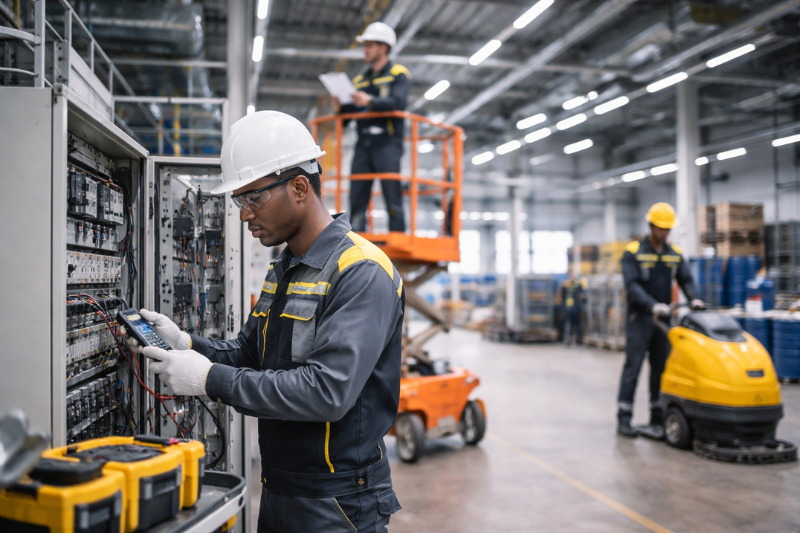
When most people think about “property maintenance,” they picture a guy in a van fixing a leaky faucet in an apartment complex or mowing the lawn at a local office park. But when you step into the world of industrial property maintenance, the scale changes entirely.
We’re talking about massive warehouses, humming manufacturing plants, chemical processing facilities, and distribution centres that never sleep. In these environments, maintenance isn’t just about keeping things looking pretty; it’s the literal heartbeat of the business.
If a faucet leaks in an office, it’s an annoyance. If a high-pressure valve fails in a factory, the entire production line stops, and you’re losing thousands of dollars every minute. So, what exactly goes into keeping these giants upright and running? Let’s break it down.
It’s More Than Just a Toolbox
At its core, industrial property maintenance is the comprehensive upkeep of the physical assets, systems, and structures within an industrial setting. It’s a specialised blend of janitorial work, high-end engineering, landscaping, and rigorous safety compliance. Unlike residential or commercial retail spaces, industrial sites have unique demands:
- Heavy-Duty Infrastructure: Think reinforced concrete floors that need to withstand 20-ton forklifts.
- Complex Systems: Massive HVAC units, specialised plumbing for industrial waste, and electrical grids that could power a small town.
- Regulatory Stakes: Safe Work Australia and other agencies aren’t just “suggestions” here. One slip-up in maintenance can lead to massive fines or, worse, accidents.
Also Read- Best Methods for Concrete Repair Cracks in 2026
The Pillars of the Trade

To understand the scope, it helps to look at the three main “buckets” that maintenance teams juggle daily.
1. Preventive Maintenance (The “Health Nut” Approach)
- It is the most critical part of the job. It’s the scheduled oil changes, the filter swaps, the roof inspections, and the “checking it twice” philosophy.
- The goal here is simple: stop the break before it happens. In an industrial setting, waiting for something to fail is a recipe for disaster.
2. Corrective Maintenance (The “Emergency Room”)
- No matter how good your preventive plan is, things will eventually go “clunk” in the night. Corrective maintenance is the rapid-response team that dives in to fix broken conveyor belts, patch roof leaks after a storm, or repair a cracked loading dock leveller.
3. Predictive Maintenance (The “Fortune Teller”)
- This is where things get high-tech. Modern industrial property maintenance uses sensors and data (often called IoT) to monitor things like vibration in a motor or heat levels in a circuit breaker.
- If the data looks weird, the team fixes it before the machine even knows it’s sick.
Why Does It Actually Matter?
You might think, “Hey, it’s just a warehouse, it can take a beating.” True, industrial buildings are tough, but they aren’t invincible. Here’s why a solid maintenance strategy is a game-changer:
- Safety First, Always: A cluttered floor leads to trips. A dusty ventilation system leads to fires. Proper maintenance keeps the people inside the building safe, which is the absolute priority.
- Protecting the Investment: Industrial real estate is expensive. A neglected roof can lead to structural rot that costs millions to fix. Regular upkeep ensures the property value stays high.
- Operational Efficiency: When the loading dock doors work smoothly and the lights are bright, the crew works faster. It’s all about removing the “friction” from the workday.
- Compliance: Staying on top of inspections for fire extinguishers, elevators, and waste management keeps the “suits” and inspectors happy.
Also Read – How to Drill Into Concrete Walls and Slabs: Tools, Tips, and Safety
The “Silent” Heroes: Landscaping and Exterior Care
People often forget that the outside matters just as much as the inside. Industrial property maintenance includes managing the “curb appeal” and functionality of the grounds. We’re talking about:
- keeping the perimeter fences secure (security is a big deal in industrial zones),
- ensuring the drainage basins don’t overflow during a monsoon, and
- keeping the massive parking lots free of potholes.
If a delivery truck blows a tyre in your parking lot because of a neglected crater in the asphalt, that’s on the maintenance team.
The Reality of the Job
It’s a gritty, hands-on, and incredibly rewarding field. It requires a “MacGyver” mindset—the ability to look at a complex problem and find a logical, safe, and cost-effective solution.
Whether it’s power-washing a grease-stained loading bay or upgrading to LED lighting to save $50,000 a year in energy costs, the people in this field are the unsung heroes of the global supply chain. Without them, the world quite literally stops moving.
Why trust Civilcraft for Industrial Property Maintenance
When it comes to industrial property maintenance in Australia, names like Civilcraft often come up as the benchmark for reliability. But in a world of slick websites and big promises, why do top-tier companies actually hand over their keys to us?
It’s not just about having the right tools; it’s about a specific “engineering-first” philosophy that sets us apart from your average maintenance service. Here is why Civilcraft has earned that “trusted” status across Australia.
- Specialisation in live-site maintenance.
- We are fundamentally a civil engineering firm.
- We manage maintenance and construction for some of Australia’s most high-pressure environments.
FAQs
Q:- How is industrial maintenance different from commercial maintenance?
Ans:- Industrial maintenance deals with much heavier machinery, harsher environments (chemicals/heat), and stricter safety regulations than your typical office or retail space.
Q:- Is landscaping included in industrial property maintenance?
Ans:- Yes! It’s crucial for drainage, security (keeping fences clear), and ensuring that heavy transport vehicles can navigate the grounds safely.
Q:- What is the highest cost in industrial maintenance?
Ans:- Usually, it’s the cost of unplanned downtime. While parts and labour cost money, losing a day of production is almost always more expensive.
Q:- How often should an industrial roof be inspected?
Ans:- At a minimum, twice a year (spring and fall). Because industrial roofs often house massive HVAC units, they deal with more foot traffic and vibration than residential roofs.
Q:- Does technology play a role in this?
Ans:- Absolutely. Many modern facilities use Computerised Maintenance Management Systems (CMMS) to track every nut and bolt in the building via tablets and cloud software.