
When you’re sitting in the terminal at Sydney or Melbourne airport, sipping a flat white and watching a massive A380 taxi toward the runway, it’s easy to focus on the “flying” part of aviation. But here’s a little secret from the industry: the most dangerous part of a flight isn’t necessarily when the plane is at 30,000 feet; it’s often when it’s on the ground.
That’s where airport ground works management comes into play. It sounds like a bit of a dry, corporate term, but in reality, it’s the high-stakes choreography that keeps millions of Australians moving safely every year.
From resurfacing a runway at midnight to managing a fleet of baggage tugs in a thunderstorm, ground works management is the invisible shield protecting flight safety. In the Australian context, where we have some of the busiest domestic routes in the world (Sydney-Melbourne), getting this right isn’t just a goal—it’s a legal and moral necessity.
What is Airport Ground Works Management?
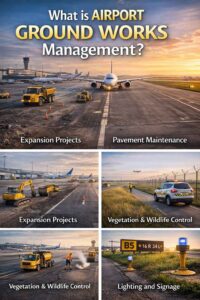
At its heart, airport ground works management is the oversight of every physical activity that happens on the “airside” of the fence. This isn’t about fixing the coffee machine in Terminal 3; it’s about the infrastructure that supports the aircraft.
Think of an airport like a mini-city that never sleeps. The “roads” (runways and taxiways) are under constant stress from planes weighing hundreds of tonnes. The “utilities” (fuel lines and electrical grids for navigation lights) are buried just beneath the surface. Management involves:
- Expansion Projects: Building new hangars or taxiway extensions.
- Pavement Maintenance: Keeping runways free of cracks and potholes.
- Vegetation & Wildlife Control: Ensuring the grass is at the right height to deter birds.
- Lighting and Signage: Maintaining the “Visual Aids” that pilots rely on during low-visibility landings.
Why Ground Works are Different in Australia
Australia presents some unique challenges for airport ground works management. We aren’t just dealing with standard wear and tear; we’re dealing with the Australian elements.
1. The Heat Factor
- In places like Perth or Darwin, the tarmac can reach temperatures that would literally melt your sneakers. This heat causes the pavement to expand and contract significantly.
- Groundwork teams have to use specific materials and management schedules to ensure the runway doesn’t buckle or crack under the weight of a landing Qantas jet.
2. The Vast Distances
- Managing a Tier-1 airport like Brisbane is one thing, but Australia is dotted with regional airstrips that are lifelines for the Royal Flying Doctor Service (RFDS) and mining charters.
- Ground works management at these remote sites is a logistical puzzle—how do you get a paving crew and heavy machinery to a remote strip in the Pilbara without disrupting emergency flights?
Also Read – What is Paving a Footpath | Guide 2026
The Critical Link to Flight Safety
So, how does fixing a patch of concrete actually save lives? In the world of aviation safety, there is a concept called FOD – Foreign Object Debris.
The War on FOD
FOD is anything that shouldn’t be on a runway. It could be a loose bolt, a piece of pavement, or a stray tool left behind by a construction crew. If a jet engine sucks up a piece of debris during takeoff, the results can be catastrophic.
Effective Airport Ground Works Management ensures that when work is done—say, installing new drainage—the site is swept, inspected, and cleared with surgical precision before a single plane is allowed back on the strip.
Runway Incursions: The Nightmare Scenario
- The most dangerous thing that can happen on the ground is a “runway incursion”, when a vehicle or person is on the runway when they shouldn’t be.
- Management teams use strict permit systems, GPS tracking on all ground vehicles, and constant radio communication with ATC to ensure that the guy fixing a lightbulb isn’t in the path of a Virgin Australia flight.
The “Art” of the Midnight Shift
One of the most stressful parts of airport ground works management is the timing. You can’t exactly shut down Sydney Airport at 2 PM on a Tuesday to fix a taxiway. In Australia, most major works happen during the “curfew” hours (11 PM to 6 AM) or in highly coordinated blocks.
- The Sprint: Teams have a tiny window to rip up a section of runway, pour new asphalt, let it cure, paint the lines, and clear the area before the first “red-eye” flight arrives from Perth at dawn.
- Precision: If the works run 15 minutes late, it can delay dozens of flights and cost the airlines millions. It’s a high-pressure race where safety can never be sacrificed for speed.
Technology: The New Frontier in Ground Works
Australia is a world leader in adopting tech for airport ground works management. We’re moving away from clipboards and moving toward:
- Drones: Used to inspect runways for cracks and to monitor wildlife patterns without putting humans in danger.
- Smart Lighting: Sensors that tell the ground crew exactly which bulb is about to fail before it actually goes dark.
- Digital Twins: Creating a 3D virtual model of the airport so managers can simulate how a construction project will affect traffic flow before a single shovel hits the dirt.
Also Read – How Pressure Cleaning Services Sydney Improve Property Value
The Human Element: Training and Culture
At the end of the day, a system is only as good as the people running it. In Australia, the Civil Aviation Safety Authority sets incredibly high standards. Anyone stepping onto the airside needs an ASIC (Aviation Security Identification Card) and specific “Airside Driving” licenses.
But beyond the permits, it’s about a Safety Culture. Ground works management involves fostering an environment where a junior worker feels comfortable stopping a multi-million dollar project if they see a single loose bolt on the tarmac. That “Stop Work” authority is what keeps the Australian aviation industry one of the safest in the world.
Conclusion
The next time you’re buckled into your seat, waiting for the engines to roar to life, take a look out the window at the pavement passing beneath you. Those yellow lines, the perfectly smooth tarmac, and the lack of a single stray pebble are all thanks to the relentless work of airport ground works management.
It’s a massive, complex, and often thankless job, but it’s the reason we can fly across this vast, beautiful continent with such peace of mind.
FAQs
Q: What is the biggest risk during airport ground works?
Ans: Foreign Object Debris (FOD) and runway incursions (unauthorised vehicles on the runway) are the top safety concerns.
Q: Does ground work happen while planes are flying?
Ans: Usually, no. Major works are scheduled for night curfews or “low-traffic” windows to keep workers and passengers safe.
Q: Who regulates airport ground works in Australia?
Ans: The Civil Aviation Safety Authority (CASA) provides the regulatory framework that all Australian airports must follow.
Q: Why is runway maintenance so frequent?
Ans: The immense weight and friction of landing aircraft cause rapid wear and tear; constant “preventative” maintenance is cheaper and safer than a total rebuild.
Q: Can the weather stop ground works?
Ans: Yes. Heavy rain or lightning can make it impossible to pour asphalt or safely operate machinery near aircraft.