
Imagine this: You’ve just finished a long day of meetings in Sydney, and you’re headed to the airport for a quick hop back to Melbourne. You check your phone, see the flight is on time, and grab a coffee. You board, the engines hum to life, and 90 minutes later, you’re home.
It’s so seamless it’s almost boring. But behind that “boring” reliability is a massive, high-stakes operation happening 24/7. While we usually think of pilots and air traffic controllers as the guardians of the sky, there is another group working mostly in the shadows: the airport maintenance teams.
In a country as vast as Australia, where we rely on aviation to connect remote mining towns to coastal capitals, airport maintenance services aren’t just about fixing things when they break. They are the backbone of safety and the reason our aviation industry is world-class.
What Does “Airport Maintenance” Actually Mean?
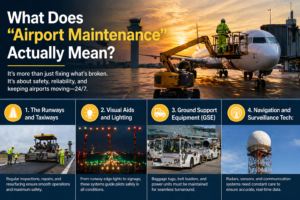
When people hear “maintenance,” they often think of an oil change for a plane. But airport maintenance is about the ground you’re standing on and everything attached to it. It’s the infrastructure that makes flight possible. In Australia, it covers a staggering amount of ground:
- The Runways and Taxiways: These aren’t just “roads.” They have to withstand the weight of a 400-tonne A380 landing at 250km/h. Maintenance teams monitor for cracks, “rubber buildup” from tyres (which makes the surface slippery), and drainage issues.
- Visual Aids and Lighting: Have you ever looked out the window during a night landing? Those thousands of twinkling lights—runway edges, approach paths, and taxiway markers—are critical. One failed circuit could mean a pilot loses their orientation.
- Ground Support Equipment (GSE): From the tugs that push the planes back to the refuelling rigs and mobile power units, these machines need constant servicing to ensure they don’t break down mid-operation.
- Navigation and Surveillance Tech: Airservices Australia maintains hundreds of ground-based beacons and satellite tech that “talk” to the planes. If these go offline, the “eyes” of the pilot go dim.
Why Australia Faces Unique Challenges

Airport maintenance in Australia isn’t like maintenance in Europe. Our environment is… well, intense.
1. The Heat Factor
- In places like Darwin or Perth, the scorching sun can cause runway tarmac to expand and even buckle. Airport maintenance crews have to use specialised materials and constant monitoring to ensure the surface stays flat and grippy.
2. The Vast Distances
- Australia manages about 11% of the world’s airspace. Maintaining a regional strip in the middle of the Kimberley is a logistical puzzle. If a navigation beacon fails out there, you can’t just run to the local hardware store. It requires a dedicated network of mobile workshops and certified technicians who can fly in at a moment’s notice.
3. Wildlife Management
- Wait, is a “bird” a maintenance issue? Absolutely. Airport maintenance services include managing the “obstacle limitation surfaces” (keeping trees trimmed) and ensuring the drainage doesn’t attract birds that could cause a strike.
The Proactive Approach: Fixing It Before It Breaks
In 2026, we’ve moved way beyond “waiting for a lightbulb to pop.” The gold standard now is predictive maintenance. Using “Digital Twins”—virtual models of the airport—engineers can simulate wear and tear.
Sensors embedded in the concrete can tell a computer, “Hey, this section of the runway is starting to sag slightly,” weeks before a human eye would notice. By fixing a small crack on a Tuesday afternoon, they prevent a massive runway closure on a Friday night. That is how you minimise delays and keep the “reliability” in aviation operations.
Compliance: The CASA Factor
In Australia, we have the Civil Aviation Safety Authority (CASA) watching over everything. They don’t take “we’ll get to it eventually” for an answer. Every airport must have a documented Aerodrome Maintenance Program. If you don’t stick to the schedule for repainting markings or testing friction levels, you lose your certification. It’s that simple.
This strictness is exactly why Australia has such an incredible safety record. When you see a “Work in Progress” sign at an airport, don’t roll your eyes at the delay—smile because it means someone is ensuring your next takeoff is as safe as humanly possible.
Also Read:- Why Water Infrastructure Services Are Essential for Sustainable Development in Australia
Conclusion
The next time you’re staring out the terminal window waiting for your boarding call, take a look at the yellow trucks driving around the tarmac. Those are the folks checking the lights, sweeping the “Foreign Object Debris” off the runway, and ensuring the complex dance of aviation keeps its rhythm.
Airport maintenance might not be the most glamorous part of travel, but it’s the reason you can trust that when the wheels touch the ground, they’re touching something solid, safe, and ready for you. For availing the best services in Sydney, contact Civilcraft.
FAQs
Q:- Does airport maintenance cause many flight delays?
Ans:- Actually, it prevents them. By doing “preventative” work during low-traffic hours (like 2 AM), teams stop major infrastructure failures that would ground flights for days.
Q:- What is FOD, and why is it a maintenance priority?
Ans:- FOD stands for Foreign Object Debris (like a stray bolt or a piece of luggage strap). If a jet engine sucks that up, it’s a disaster. Maintenance crews spend hours sweeping the “manoeuvring areas” to keep them spotless.
Q:- Who is responsible for maintaining regional Aussie airports?
Ans:- It’s usually a mix. Local councils often own the land, but they hire specialised airport maintenance services to handle the technical stuff like lighting and runway friction testing.
Q:- How often are runways “resurfaced”?
Ans:- It depends on traffic, but a major runway usually gets a “deep” makeover every 10–12 years. However, small “patch and seal” jobs happen almost weekly.
Q:- Can drones help with airport maintenance?
Ans:- Yes! In 2026, drones are commonly used to inspect high-mast lighting and terminal roofs, and even to map runway cracks, keeping technicians safe and saving time.