You’re walking down a familiar path, maybe scrolling through your phone or juggling a coffee, and suddenly—thump. Your foot catches on a jagged edge of concrete that wasn’t sticking up yesterday. You stumble, save the coffee (hopefully), and shoot a dirty look at the ground.
While a tripped toe is a nuisance, for businesses and local councils across the country, those cracks are a ticking time bomb. In the scorching Australian sun and the sudden flash floods we’ve been seeing lately, our ground is constantly moving. And when the ground moves, our pavements pay the price.
If you’re staring at a driveway, a loading dock, or a public walkway that looks more like a jigsaw puzzle than a solid surface, it’s time to talk about paving repairs. Waiting “just one more season” usually means the repair bill grows as fast as the weeds in those cracks.
The Hidden Dangers: Why “Small” Cracks are a Big Deal
In Australia, we take our outdoor lifestyles seriously. But whether it’s a bustling Sydney sidewalk or a quiet Melbourne suburban driveway, a cracked surface is a major safety hazard.
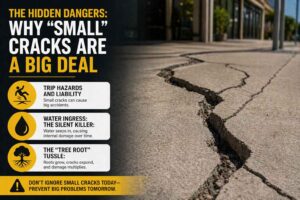
- Trip Hazards & Liability
Under Australian liability laws, if you own or manage a property, you have a duty of care to ensure the walking surfaces are safe. A vertical displacement of just 10mm is often enough to be classified as a trip hazard. If a delivery driver or a pedestrian takes a tumble on your watch, “I didn’t get around to it” won’t hold up in court.
- Water Ingress: The Silent Killer:
When it rains, water seeps into the crack and gets under the pavement slab. It softens the sub-base (the soil and gravel holding everything up). Once that base turns to mud, the heavy weight of cars or even foot traffic causes the pavement to sink further. This is why pavement repair services Australia wide emphasise sealing cracks early before the entire slab collapses.
- The “Tree Root” Tussle:
We love our native gums and leafy street trees, but their roots are incredibly strong. As they grow, they can lift heavy concrete pavers like they’re made of cardboard. Without professional paving repairs, those roots will keep pushing until the path is completely impassable.
Modern Solutions: How the Pros Fix It
Gone are the days when the only solution was to bring in a jackhammer and start from scratch. Modern pavement repair services in Australia utilise some pretty clever tech to fix surfaces with minimal disruption.
-
Patching & Crack Sealing
For minor wear and tear, specialised bitumen or polymer-based fillers are used. These aren’t just “glue”; they are designed to be flexible. Australia’s temperature swings mean pavements expand in the heat and contract in the cold. A rigid filler will just pop back out, but a professional-grade sealant moves with the pavement.
-
Trip Hazard Grinding
If one slab has lifted slightly higher than the one next to it, professionals often use a technique called “scarifying” or grinding. They essentially shave down the high edge to create a smooth, tapered transition. It’s fast, cost-effective, and removes the safety risk without needing to pour new concrete.
-
Reinforcing & Underpinning
If the ground has sunk, some experts use “poly-levelling.” They inject a high-density foam underneath the sunken slab. As the foam expands, it lifts the pavement back to its original height. It’s like magic, and you can usually walk on it within minutes.
Why Quality Matters in the Australian Climate
It’s tempting to grab a bag of quick-set premix from the local hardware store and slap it into a hole. But in Australia, the UV index and soil salinity can be brutal. Professional paving repairs focus on the cause, not just the symptom. If your pavement is cracking because of poor drainage, a pro will fix the drainage first.
If you just fill the crack, you’re essentially putting a Band-Aid on a broken leg. Working with established pavement repair services, like Civilcraft, ensures that the materials used are rated for our specific conditions, whether that’s the humidity of Queensland or the dry heat of WA.
Maintaining Your Asset
Think of your pavement like your car. You wouldn’t wait for the engine to explode before getting an oil change.
- Keep it clean: Sweeping away debris prevents organic matter from rotting in small crevices.
- Watch the weeds: If you see green peeking through your pavers, kill it fast. Roots expand and turn hairline fractures into gaping holes.
- Check after storms: Heavy rain is the number one catalyst for pavement failure in Australia. Do a quick walk-around after a big “southerly buster” to see if any new sinking has occurred.
Also Read:- Concrete Cracks Getting Worse? Effective Concrete Repair Solutions in Australia
Conclusion
At the end of the day, paving repairs aren’t just about making things look “pretty”, though a smooth, clean path certainly helps with curb appeal. It’s about safety, protecting your investment, and having peace of mind.
Whether you’re dealing with a residential driveway or a massive commercial parking lot, staying on top of your pavement repair services in Australia ensures that everyone gets from A to B with their ankles and their coffee intact.
FAQs
Q:- How do I know if a crack needs professional paving repairs?
Ans:- A good rule of thumb is the “coin test.” If you can fit a $2 coin vertically into the crack, or if the height difference between two slabs is more than the thickness of that coin, it’s a trip hazard that needs professional attention.
Q:- Is it cheaper to repair or replace a pavement?
Ans:- Repairing is almost always significantly cheaper, often 70-80% less than a full replacement. However, if more than 30% of the surface is damaged or the sub-base has completely washed away, a professional might recommend replacement for long-term safety.
Q:- How long do pavement repair services in Australia typically take?
Ans:- Most minor repairs, like crack sealing or hazard grinding, can be done in a few hours. Even more complex jobs like slab lifting usually take less than a day, meaning your driveway or storefront isn’t out of action for long.
Q:- Can you fix moving pavers”?
Ans:- Yes! It is usually caused by the “bedding sand” washing away. A pro can lift the affected pavers, relevel the base, and use a specialised “polymeric sand” that hardens to lock the pavers in place and prevent future washouts.
Q:- Does insurance cover paving repairs?
Ans:- Usually, insurance won’t cover repairs caused by “wear and tear” or tree roots. However, they do care about liability. Keeping your pavements maintained can actually help you avoid massive insurance claims or premium hikes resulting from accidents on your property.