If you’ve spent five minutes on a construction site in Sydney, Melbourne, or out in regional WA lately, you know that a “perfect” project is about as rare as a cool day in January. In the world of infrastructure, two ghosts haunt every site office: Project Delays and Budget Overruns.
In 2026, the stakes are even higher. With material costs fluctuating and the Aussie labour market tighter than a rusted bolt, knowing how to construct civil projects without losing your shirt (or your sanity) is a specialised skill.
Whether you’re looking at a subdivision, a new road, or a complex drainage system, the secret isn’t just in the digging; it’s in the data and the partnership. If you want to keep your project on the rails, here is the “no-nonsense” guide to civil construction Australia.
Why “She’ll Be Right” Doesn’t Work Anymore
For a long time, the Australian approach to civil works was a bit reactive. We’d hit a patch of unexpected rock or a week of torrential rain and just say, “She’ll be right, we’ll make it up in the next phase.” But in today’s economic climate, “making it up” usually means a 20% budget blowout. The primary reasons we see projects stall today are:
- Scope Creep:- Adding “just one more thing” to the design once the concrete is already pouring.
- Incomplete Site Investigations:- Not knowing what’s under the ground before the excavators arrive.
- Fragmented Communication:- The designer, the council, and the contractor are all reading from different playbooks.
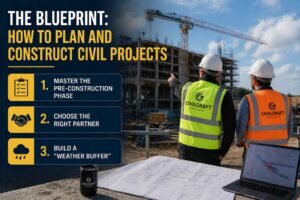
The Blueprint: How to Plan & Construct Civil Projects
To avoid the dreaded “red ink” on your balance sheet, you need a strategy that covers the project from the first survey to the final inspection.
1. Master the Pre-Construction Phase
- You can’t build a solid structure on a shaky plan. Before you even think about the “construct” phase, you need a deep dive into the site’s DNA. It means geotechnical reports that are actually thorough and utility mapping that doesn’t leave “surprises” for the trenching crew.
2. Choose the Right Partner
- This is where the rubber meets the road. In the realm of civil construction Australia, your choice of contractor is the biggest variable in your budget. You want a team that understands the local regulatory landscape—someone like Civilcraft.
- A partner like Civilcraft doesn’t just provide labour; we provide the “boots on the ground” expertise needed to navigate Australian standards and environmental hurdles. When you work with specialists who have a track record in high-stakes infrastructure, you aren’t just paying for a service; you’re buying insurance against incompetence.
3. Build a “Weather Buffer”
- We live in Australia. Between La Niña cycles and sudden heatwaves that prevent concrete from curing properly, your timeline needs to breathe. A pro-level plan includes a 10–15% time contingency specifically for weather. If you don’t need it, you finish early. If you do, you aren’t explaining a “delay” to your stakeholders.
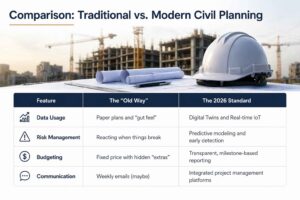
Comparison: Traditional vs. Modern Civil Planning
The Tech Edge: Beating the Budget in 2026
If you want to construct civil assets efficiently this year, you have to embrace the tech. We’re seeing more Australian firms use:
- Drones for Progress Tracking:- Weekly drone flyovers provide a “bird’s eye view” of the site, ensuring that the project is physically where the reports say it is.
- 3D Machine Control:- Excavators guided by GPS and 3D models. It means we dig it right the first time, no over-excavating, no wasted fuel, and no costly rework.
- BIM (Building Information Modelling):- This allows us to “build” the project in a virtual space first. We find the “clashes” (like a water pipe hitting a structural pier) on a computer screen rather than with a shovel.
How Civilcraft Makes a Difference
When looking for civil constructors in Australia, you need a firm that bridges the gap between big-picture engineering and “dirt-under-the-fingernails” reality. Civilcraft has carved out a reputation for exactly that.
By focusing on smart resource allocation and clear-eyed risk assessment, they help developers and government bodies avoid the common pitfalls that lead to those 30% budget overruns we all dread.
Also Read:- Old & Damaged Concrete? Concrete Resurfacing Sydney for a Cost-Effective Fix
Closing Thoughts
Planning to construct civil projects doesn’t have to be a gamble. By investing in the right tech, being realistic about the Australian climate, and partnering with seasoned pros like Civilcraft, you can turn those “inevitable” delays into manageable milestones.
FAQs
Q:- What is the #1 cause of project delays in Australia?
Ans:- Weather is the most common, but “unforeseen ground conditions” (hitting rock or contaminated soil) is the most expensive. Thorough pre-site testing is the only cure.
Q:- How do I stop “Scope Creep” from ruining my budget?
Ans:- Establish a “Change Order” protocol on day one. Any change to the original plan must be priced and signed off before the work starts, not after.
Q:- Is it better to hire a local or national civil firm?
Ans:- Local knowledge is king. Civilcraft understands local council quirks and soil types better than a massive multinational based overseas.
Q:- What is a “Liquidated Damages” clause?
Ans:- It’s a part of the contract that sets a daily rate the contractor pays if they miss the deadline without a valid excuse. It keeps everyone focused on the finish line!
Q:- How much contingency should I have in my budget?
Ans:- For civil construction projects in Australia, we recommend a minimum of 10% for “known unknowns” and up to 20% for high-risk or brownfield sites.