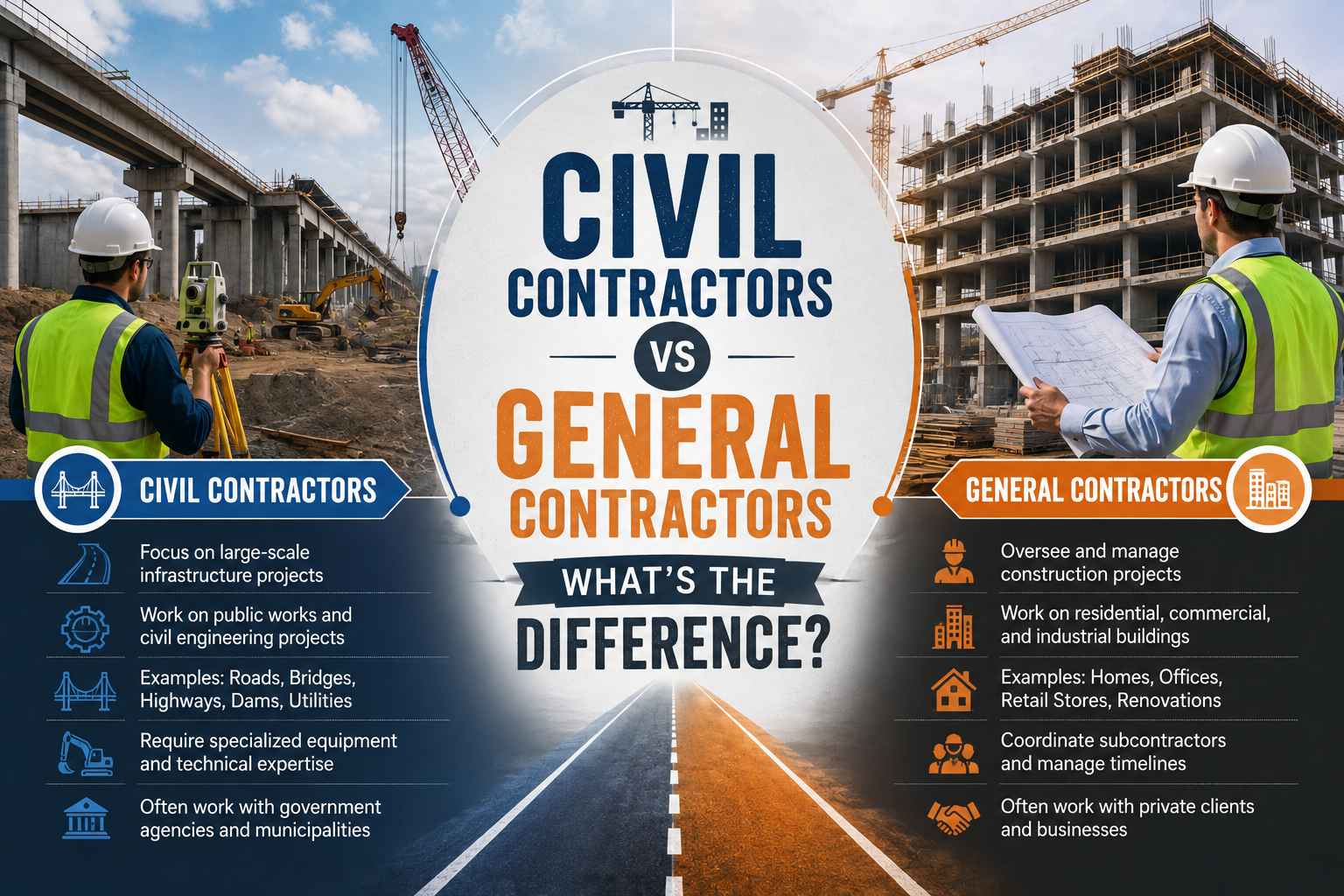
When you’re kicking off a big construction project, the jargon can feel like a whole new language. You hear people tossing around terms like “trade contractor,” “civil contractor,” and “general contractor.” While “civil contractor” and “general contractor” sound like they might do the same thing—manage builders and build stuff—they operate in completely different worlds.
Hiring the wrong one for your project can lead to massive delays, blown budgets, or a build that quite literally lacks ground support. So, what is the actual difference between civil contractors vs general contractors? Let’s strip away the buzzwords and break it down in simple terms.
The Big Picture: Horizontal vs. Vertical Construction
The easiest way to understand the difference between these two construction giants comes down to a simple directional rule: horizontal vs. vertical.
- General Contractors build vertically, up into the sky. They focus on structures with roofs, walls, and indoor spaces.
- Civil Contractors build horizontally, across the earth. They focus on infrastructure, earthworks, water networks, roads, and land preparation.
If you want to build a 10-story apartment complex, you hire a general contractor. But if you need to clear the raw bushland, level the dirt, install underground sewer pipes, and pave the access road before that apartment building can even be designed, you need a civil contractor.
What Does a General Contractor Do?
A General Contractor is the master coordinator of building projects. When someone talks about “the builder,” they are usually talking about a general contractor. Their main job is to take a set of architectural blueprints for a structure and bring it to life safely, on time, and on budget.
Primary Responsibilities of a General Contractor:
- Building Structures: They focus on residential homes, office towers, shopping centers, warehouses, and hospitals.
- Permits & Building Codes: They ensure the building complies with local council building codes, fire safety standards, and zoning laws.
- Interior & Exterior Finishes: They oversee everything from laying the concrete slab to hanging drywall, installing kitchen cabinets, and painting walls.
- Subcontractor Management: GCs rarely do all the physical work themselves. Instead, they hire and manage specialised trades—electricians, plumbers, carpenters, plasterers, and painters.
In short, a general contractor coordinates human skill sets to build a self-contained, functional building where people can live, work, or shop.
What Does a Civil Contractor Do?
A Civil Contractor focuses on heavy infrastructure and civil engineering works. They shape the environment to support human living. Without civil contractors, general contractors wouldn’t have flat land to build on or roads to transport materials into their buildings.
Civil contracting requires massive earthmoving machinery, specialised engineering knowledge, and a deep understanding of soil mechanics, hydraulics, and environmental impacts.
Primary Responsibilities of a Civil Contractor:
- Marine & Heavy Works: Constructing dams, sea walls, port terminals, and retaining walls.
- Transport Infrastructure: Building highways, city streets, bridges, airport runways, and railway lines.
- Foundation Sub-Bases: Preparing heavy-duty ground foundations capable of holding immense structural loads.
- Earthworks & Site Preparation: Clearing trees, blasting rock, mass excavation, land grading, and soil compaction.
- Underground Utilities: Installing bulk stormwater systems, water mains, sewage networks, and underground electrical conduits.
While a general contractor manages tradespeople like carpenters and tilers, a civil contractor manages heavy plant operators (excavators, bulldozers, graders) and civil engineers.
Civil Contractors vs General Contractors: Key Differences at a Glance
To make things crystal clear, here is a quick side-by-side comparison of how these two roles operate on a job site:
|
Feature |
General Contractor (GC) | Civil Contractor |
|
Primary Focus |
Vertical structures (Buildings, Homes, Offices) |
Horizontal infrastructure (Roads, Pipes, Land) |
|
Work Environment |
Above-ground structures, indoor/outdoor building sites |
Raw land, transport corridors, underground |
|
Primary Workforce |
Tradies (Electricians, Plumbers, Carpenters) |
Plant operators (Excavators, Dozers), Civil Engineers |
|
Key Equipment |
Scaffolding, hand tools, cranes, concrete pumps |
Heavy earthmovers, rollers, trenchers, vacuum diggers |
|
Core Goal |
Creating habitable, functional indoor/outdoor spaces |
Creating durable, safe public & site infrastructure |
When Do You Need Which?
Knowing when to hire a civil contractor versus a general contractor depends entirely on what stage your project is at—and what you are trying to construct.
Hire a Civil Contractor when:
- You are building a road, large parking lot, bridge, or subdivision infrastructure.
- You have a piece of raw land that needs clearing, leveling, or major earthmoving.
- You need specialised non-destructive digging or utility locating around live assets.
- You need to install underground drainage, sewer mains, or stormwater retention systems.
Hire a General Contractor when:
- You are ready to construct a house, apartment block, office, or commercial shed.
- You are doing a major interior renovation, fit-out, or structural extension to an existing building.
- You need someone to manage building permits, architectural specs, and specialised building trades.
The Power of Working Together
On large-scale developments, like a new housing estate or a commercial shopping hub, you actually need both. The civil contractor moves in first to carve out the land, lay underground pipes, and build access roads. Once the site is stable and fully serviced, the general contractor takes over to erect the actual buildings!
Also Read:- Why Non Destructive Digging is the Safest Excavation Method
Final Thoughts
While both types of contractors are essential to the construction industry, their expertise couldn’t be more distinct. General contractors build the spaces where we live and work, while civil contractors build the foundational world that makes modern living possible.
Understanding the unique divide between civil contractors vs general contractors ensures you hire the right team from day one, keeping your project safe, compliant, and built on solid ground!
FAQs
Q:- What is the difference between a civil contractor and a general contractor?
Ans:- General contractors construct vertical structures like buildings and homes, while civil contractors focus on horizontal earthworks and infrastructure like roads, bridges, and underground utilities.
Q:- When should I hire a civil contractor instead of a general contractor?
Ans:- Yes, civil contractors can manage commercial projects, particularly for heavy site preparation, bulk earthworks, parking facilities, and civil infrastructure components.
Q:- Can civil contractors manage commercial construction projects?
Ans:- Hire a civil contractor when your project involves land clearing, site grading, roadwork, drainage, or heavy utility installation before vertical building construction begins.
Q:- What services do civil contractors typically provide?
Ans:- Civil contractors typically provide bulk earthworks, land clearing, road building, stormwater drainage installation, non-destructive digging, and infrastructure maintenance.
Q:- How do I choose the right civil contractor in Sydney?
Ans:- Look for a Sydney civil contractor with proven local project experience, proper safety accreditations and licences, modern heavy plant equipment, and strong client references.