
When constructing high-security defence sites, civil engineering isn’t just about concrete, steel, and design; it’s about strategy, risk management, and absolute precision. Defence site construction in Australia demands more than just technical know-how.
It requires a deep understanding of security protocols, restricted access logistics, and an unwavering commitment to national safety. Let’s explain how civil engineering is critical in delivering secure and resilient infrastructure for defence operations across Australia.
Why Defence Site Construction in Australia Is Different
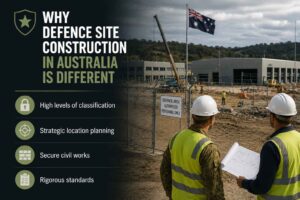
Defence infrastructure isn’t your typical commercial or residential project. These sites are the backbone of Australia’s national security, used for military training, weapons storage, surveillance, and advanced communication networks.
The requirements are strict. Timelines are tight. Security clearances are non-negotiable. Here’s what sets defence site construction apart:
- High levels of classification:- Not all contractors can access project details.
- Strategic location planning:- Many projects are in remote or classified areas, requiring specialised logistics.
- Secure civil works:- From reinforced bunkers to sensitive communication hubs, every structure must be fortified against threats, physical and digital.
- Rigorous standards:- All builds must meet Defence Estate Quality Management Systems (DEQMS), national codes and military-specific standards.
In other words, to construct civil infrastructure for defence is equivalent to building with one hand tied behind your back; only the best teams succeed.
Core Civil Engineering Requirements for Defence Projects
1. Site Access and Control
Access control must occur before a single truck rolls onto the site. It includes perimeter fencing, surveillance, guardhouses, and biometric systems. Civil engineers design and implement the groundwork that enables:
- Secure personnel and vehicle checkpoints
- Redundant access roads in case of emergencies
- Vehicle mitigation systems (bollards, boom gates)
It’s not just about keeping people out; it’s about controlling who and what goes in and out at all times.
2. Earthworks and Ground Stabilisation
Solid foundations, whether building an underground bunker or a surveillance tower, are non-negotiable. Defence sites often require:
- Flood risk management
- Rock blasting and excavation
- Contaminated soil remediation
Special attention is paid to seismic stability, blast resistance, and long-term durability, particularly in remote areas or active zones.
3. Secure Utility Networks
Civil engineers handle the underground lifelines of any defence site: water, sewer, power, and data lines. But here, they must be:
- Redundant (backups for critical systems)
- Buried deep or routed through hardened conduits
- Shielded (from EMPs, sabotage, and cyber threats)
Every wire and pipe is a potential vulnerability. The goal is to build networks that can’t be disrupted easily, even in the event of an attack or a disaster.
4. Structural Resilience and Fortification
Once the groundwork is complete, engineers move on to fortified structures:
- Aircraft hangars
- Operations centres
- Ammunition storage bunkers
- Sensitive equipment shelters
These aren’t regular buildings. Many must withstand blasts, high winds, fires, or chemical exposure. Engineers must select materials and designs that meet functional and protective requirements, often including reinforced concrete, blast-proof doors, and secure access compartments.
5. Drainage, Flood, and Fire Management
Defence sites are built to keep operating in extreme conditions. That means:
- Foam suppression systems for aircraft or fuel areas
- Bushfire-resistant zones, especially in rural Australia
- Redundant pumping stations and backup water supply
- Advanced stormwater systems that prevent flooding of underground bunkers
A fire or flood at a high-security base isn’t just a disruption; it’s a potential national security risk. Planning for these contingencies is key.
Secure Civil Works: Integrated from Day One
Security isn’t just something that’s added at the end. It’s embedded into the design, construction, and even the selection of contractors. Here’s what it involves:
- Data protection: Digital plans and schematics are stored in secure, encrypted environments.
- Specialist equipment: Tools and materials are logged, secured, and sometimes tracked with RFID.
- On-site protocols: No phones, no USBs, no photography. Everything is tightly controlled.
- Contractor vetting: All personnel on site must have security clearance. Subcontractors are scrutinised just as closely.
This level of control ensures that defence infrastructure is not just strong, but secret.
Risk-Managed Constructions: Reducing Unknowns
In high-stakes defence projects, there’s no room for surprises. That’s where risk-managed builds come in. It’s a planning approach that civil engineers use to reduce uncertainties, cost overruns, and delays. It involves:
- Detailed risk registers for each phase of construction
- Secure procurement chains that avoid reliance on unknown or untrusted sources
- Contingency planning for supply chain interruptions, weather delays, or geopolitical issues
- Red team reviews, where external experts try to break or compromise the plan before it’s implemented
Risk-managed construction is about building with the future in mind, considering every scenario and threat anticipated.
Remote and Harsh Environments: A Common Challenge
Australia’s defence network stretches across deserts, jungles, coastlines, and remote islands. Civil engineers must know how to build in:
- Cyclone-prone coastal zones
- Extreme heat and UV exposure
- Regions with limited road or rail access
It means sourcing durable materials, using fly-in-fly-out labour models, and relying on modular or pre-fab structures that can be assembled quickly with minimal footprint.
Sustainability in Defence Infrastructure
Even in defence site construction, sustainability matters. Energy and water efficiency are part of the plan even in secure environments. The Department of Defence has committed to reducing emissions and energy use across its estate. Civil engineers contribute by:
- Minimising land disturbance and preserving local ecosystems
- Designing solar-ready and energy-efficient facilities
- Using recycled materials and low-carbon concrete
- Implementing smart lighting and HVAC systems
Choosing the Right Civil Contractor for Defence Projects
Not every contractor is equipped to work on defence projects. Look for those who:
- Are prequalified under Defence Infrastructure Panels
- Have experience with civil delivery models (especially D&C or ECI)
- Maintain a clean security record and be familiar with DEQMS and ASDEFCON
- Have experience with modular, remote, or risk-managed construction
It’s not just about getting the job done. It’s about completing it right, without compromise, and with complete discretion. And Civilcraft is a civil contractor in Sydney who can perform these tasks for you.
Also Read:- Preventative Asphalt Maintenance for Australian Ports
Final Thoughts
Defence site construction in Australia is one of the most complex and sensitive branches of civil engineering. Every decision is tied to national safety, from risk-managed construction to secure civil constructions.
And while the work is technical, the goal is simple: deliver infrastructure that protects Australia, even in the worst-case scenario. Whether constructing hardened shelters or laying EMP-resistant data lines, civil engineers are on the front lines of defence, quietly shaping the physical backbone of national security.
FAQs
Q. What is defence site construction in Australia?
Ans:- It refers to building secure, high-spec military or national security facilities, including training centres, bases, bunkers, and communication hubs.
Q. What are secure civil works?
Ans:- These civil engineering activities integrate security measures at every stage, from fencing and access control to blast-proof structures and fortified utilities.
Q. What makes risk-managed builds important?
Ans:- They help avoid surprises and delays by planning for every potential threat or obstacle, ensuring projects finish safely, securely, and on time.
Q. Can any civil contractor work on defence projects?
Ans:- No. Contractors must be vetted, often prequalified by the Department of Defence, and able to operate under strict security conditions.
Q. Is sustainability considered in defence construction?
Ans:- Yes. Modern defence infrastructure includes energy efficiency, water conservation, and low-impact materials where possible, even in high-security builds.