
Concrete wears down.
That’s just the reality of buildings, bridges, pavements, and industrial floors. But here’s the thing: repairing that damage used to mean big machinery, loud noise, dusty messes, and sections shut down for days.
Not anymore.
Welcome to the era of non-disruptive concrete repair. This isn’t just a fancy industry buzzword, it’s the difference between halting operations vs. fixing issues quietly in the background.
Thanks to new technologies, civil contractors can now repair concrete faster, cleaner, and smarter than ever. Let’s break down what’s changing, in the field of fast-setting concrete Australia.
Also, we will discuss how it works and why it matters, especially in places like Australia, where time, safety, and environmental care are front and centre.
The Problem with Traditional Concrete Repairs
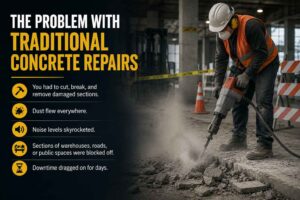
In the past, repairing concrete was a headache:
- You had to cut, break, and remove damaged sections.
- Dust flew everywhere.
- Noise levels skyrocketed.
- Sections of warehouses, roads, or public spaces were blocked off.
- Downtime dragged on for days.
It wasn’t ideal for hospitals, warehouses, airports, retail centres, or anywhere people still needed to be around. That’s where non-disruptive, smart civil solutions come in.
So What’s Changing?
Here are the key innovations reshaping concrete restoration:
1. Fast-Setting Concrete in Australia
Let’s start with the game-changer. Fast-setting concrete is exactly what it sounds like: mixes that cure in hours, not days. Whether it’s a commercial driveway or a warehouse loading dock, downtime is reduced dramatically with this concrete.
Fast-setting concrete in Australia is especially helpful because extreme weather conditions interfere with standard curing times here. These mixes don’t sacrifice strength for speed. Many are designed to meet or exceed the compressive strength of traditional concrete. Some fast-setting concretes can be:
- Traffic-ready in under 2 hours
- Mixed on-site with minimal tools
- Used in temperatures ranging from 5°C to 35°C
It makes them ideal for emergency repairs, remote site work, and even night shifts in urban areas.
2. Dust-Free Methods
Remember the mess from traditional repairs? That’s getting phased out. New techniques focus on dust-free methods, including grinding, cutting, and patching, especially in sensitive environments like:
- Schools
- Hospitals
- Retail outlets
- Food processing plants
Vacuum-assisted tools, HEPA-filtered grinders, and water-based cutting systems are now standard in high-end repair jobs. It protects the workers and the environment while allowing repairs without shutting down entire areas. Some civil teams even use self-contained enclosures to isolate work zones, keeping the rest of the site clean and operational.
3. Smart Civil Solutions for Site Planning
Technology’s not just in the tools, it’s in the planning. Smart civil infrastructure solutions now include:
- Predictive maintenance software
- Digital project management dashboards
- 3D scanning to detect subsurface issues
- Infrared thermography for moisture mapping
These tools help civil contractors in Australia pinpoint the damage without tearing everything up. You can now see what’s happening underneath the concrete before deciding what to do. Plus, clients get transparency. They can view real-time updates, photos, and reports through mobile dashboards, a big win for project communication.
4. Low-Noise Repair Equipment
When working in residential areas or commercial centres, noise is a dealbreaker. Civil teams are switching to low-noise cutting and repair systems, think battery-powered saws, electric scarifiers, and polymer injection tools instead of jackhammers. Less noise means:
- Better neighbour relationships
- Ability to work outside standard hours
- Fewer complaints from nearby businesses
This kind of privilege was unheard of in the old initial days of civil work. Now it’s becoming the default.
5. Concrete Repair Products That Bond Without Bulk
The final innovation? Bonding agents and overlays that do more with less. New concrete repairing compounds can:
- Self-level for smooth finishes
- Bond to old concrete without full removal
- Resist chemicals, water, and thermal shock
- Be feathered out without creating trip hazards
Epoxy and polyurethane-based repair kits are especially popular in fast-paced industries like logistics and manufacturing. They offer high tensile strength and are practically invisible once cured.
Real-World Impact: A Quick Case Study on Non-Disruptive Concrete Repair
Let’s say you run a warehouse in Sydney. One of your forklift zones develops a crack, maybe from expansion and contraction in the slab. Previously, you’d shut it down for 3-4 days.
Now? With fast-setting concrete in Australia and dust-free prep tools, the job is done overnight:
- Grinding is quiet and clean
- Cracks are filled with a fast-curing polymer
- Surface is restored and traffic-ready before morning
No delays. No lost revenue. No complaints. That’s the beauty of modern concrete repairing solutions.
Why This Matters for Australian Projects
Australia has strict safety standards and environmental rules. It also has remote sites, unpredictable weather, and rising labour costs. That means every hour saved matters. These innovations allow civil contractors to:
- Save clients money
- Finish projects faster
- Maintain safety compliance
- Minimise environmental impact
It’s not just about fixing what’s broken; it’s about doing it smarter.
Also Read:- Civil Engineering Solutions for High-Security Defence Sites
Final Thoughts
Concrete restoration doesn’t have to be loud, messy, or slow anymore. With fast-setting concrete in Australia, dust-free techniques, and innovative planning tools, the industry is stepping into a new era where downtime is optional and disruption is a thing of the past.
So next time someone says concrete work is a hassle, point them toward the tools and tech changing everything. For any type of help connect with civil experts at Civilcraft.
FAQs
Q:- What is fast-setting concrete, and where is it used in Australia?
Ans:- Fast-setting concrete is a specially formulated mix that cures in hours, not days. It’s commonly used in high-traffic areas like loading docks, roads, and commercial floors where downtime needs to be minimal.
Q:- Are dust-free concrete restoration methods effective?
Ans:- Yes. Modern dust-free systems use vacuum-assisted tools and water-based cutters to minimise debris and airborne particles, making them ideal for sensitive environments like hospitals or retail stores.
Q:- What are some examples of smart solutions in concrete repair?
Ans:- Smart solutions include 3D scanning, digital project tracking, and predictive maintenance software. These help contractors detect issues early and plan non-invasive repairs with precision.
Q:- How durable are fast-setting or polymer-based repair materials?
Ans:- Highly durable. Most are designed to meet or exceed traditional concrete strength and are resistant to water, chemicals, and heat. They also bond well with existing surfaces, reducing the risk of future cracking.
Q:- Can these modern repair methods be used in outdoor settings like roads or driveways?
Ans:- Absolutely. Many of these innovations are built for outdoor use, especially in Australia’s varied climate. Fast-setting mixes and overlay products work well in city streets and rural driveways.