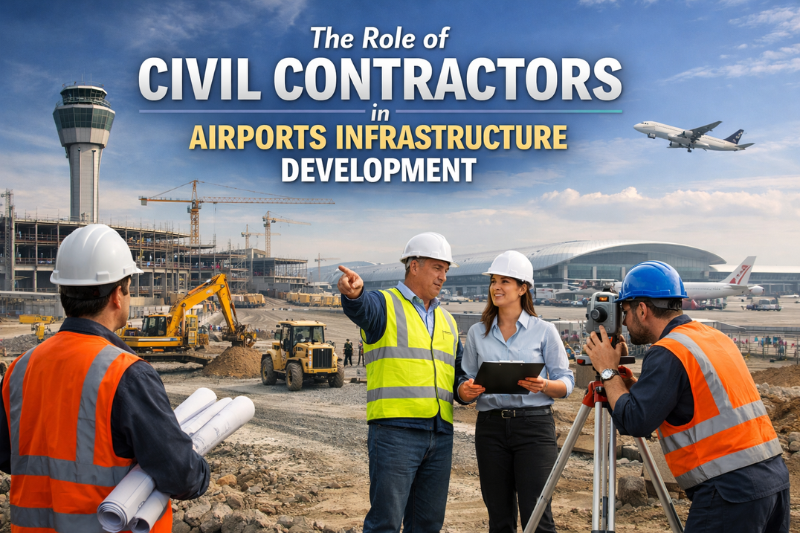
When we think about air travel, our minds usually drift to sleek jet engines, duty-free shopping, or the relief of finally hitting the “on-board” Wi-Fi. We rarely think about the literal ground beneath the wheels.
Yet, before a single passenger can board a flight, a massive, complex analysis of engineering and construction must take place. Building and maintaining airports infrastructure is a high-stakes game.
It’s not just about laying some asphalt and calling it a day. It’s about precision, extreme durability, and a level of safety where there is absolutely zero room for error.
This is where specialized civil contractors for airport infrastructure come into play. They are the unsung heroes who ensure that runways stay smooth, taxiways stay clear, and the entire facility remains operational 24/7.
Why Airports Infrastructure is a Different Beast
Most civil engineering projects, like building a local road or a parking lot, have a bit of wiggle room. If a suburban street has a small dip, it’s a minor annoyance. If a runway has a 2-centimeter deviation, it’s a safety hazard for a 400-tonne aircraft landing at 250 km/h.
Airport infrastructure services require a deep understanding of specialized materials and heavy-duty load-bearing requirements. Civil contractors must manage:
- Massive Load Stress: Runways must withstand the repeated impact of heavy aircraft.
- Compliance: Strict adherence to aviation safety standards (like CASA in Australia) is non-negotiable.
- Time Sensitivity: Airports never sleep. Most maintenance has to happen in “possession windows”—tight 4-to-6-hour slots overnight where the contractor must move in, complete the work, and be gone before the first morning flight.
The Essential Toolkit of Airport Civil Works

To keep an airport running, contractors rely on a specific set of high-skill services. Let’s look at the critical components that keep the wings in the air.
1. Concrete Resurfacing and Heavy-Duty Paving by Civilcraft
- Runways and aprons are under constant assault from heat, friction, and weight. Over time, the surface degrades. Specialized concrete resurfacing in Sydney and other major hubs is essential to prevent “Foreign Object Debris”.
- Even a small chunk of loose concrete sucked into a jet engine can cause millions of dollars in damage. Contractors use quick-setting mixes that allow the surface to be ready for traffic just hours after being poured. It’s a race against the clock that requires expert coordination.
2. Precision Paving Repairs
- It’s not just the runways that matter. The landside infrastructure—the areas where passengers walk, buses park, and luggage carts zip around—needs constant attention.
- Paving repairs in these high-traffic zones prevent trip hazards and ensure that the “ground game” of the airport remains efficient. Whether it’s asphalt patching or interlocking pavers for aesthetic terminal entrances, the finish must be flawless.
3. Structural Integrity: Sandstone Block Walls
- Airports aren’t always flat. Often, significant earthworks are required to create level runways on uneven terrain. It requires robust retaining solutions. In regions like New South Wales, sandstone block walls are a popular and highly effective choice.
- They provide the massive structural weight needed to hold back embankments while offering a natural, professional finish that integrates well with the surrounding landscape.
- They are durable, fire-resistant, and require almost zero maintenance once installed—perfect for the “set and forget” mentality needed for large-scale infrastructure.
Civilcraft: Setting the Standard in Sydney
If you are looking for the gold standard in this field, Civilcraft stands out as the best civil contractors in Sydney. With a proven track record of handling complex infrastructure projects, they bring a level of professionalism that is mandatory for aviation environments.
Civilcraft specializes in the exact type of high-pressure, high-precision work that airports demand. From intricate airport infrastructure services to large-scale civil projects, their team understands that “good enough” isn’t an option.
Their expertise in everything from civil maintenance to specialized structural work makes them the go-to partner for ensuring Sydney’s transport hubs remain world-class.
The Human Element: Managing the Chaos
Beyond the machinery and the materials, the role of a civil contractor is about logistics management. An airport is a city that never closes. A contractor must coordinate with Air Traffic Control, security teams, and airport operations.
They need to ensure that their equipment doesn’t interfere with radar signals and that every worker on-site has the correct security clearances. It’s a logistical puzzle that only the most experienced firms can solve.
Looking to the Future: Smart Infrastructure
As we move further into the 2020s, the role of the civil contractor in airports infrastructure is evolving. We are seeing “smart” pavements with embedded sensors that tell operations when a runway is getting too hot or when the structural integrity is beginning to wane.
Sustainable materials are also becoming a priority, with recycled aggregates being used in landside paving to reduce the carbon footprint of the facility.
FAQs
Q:- How long does a typical runway resurfacing last?
Ans:- Depending on traffic volume and weather, a high-quality runway surface typically lasts 10 to 15 years before requiring significant resurfacing or rehabilitation.
Q:- Why is concrete used instead of asphalt in some airport areas?
Ans:- While runways often use asphalt for flexibility, “aprons” (where planes park) usually use concrete. It is because concrete is resistant to jet fuel spills, which can damage asphalt.
Q:- What is “FOD” and why do contractors worry about it?
Ans:- FOD stands for Foreign Object Debris. It refers to any loose item (like a piece of pavement) on a runway. Civil contractors must ensure surfaces are perfectly bonded to prevent debris from being sucked into engines.
Q:- Are sandstone block walls purely decorative?
Ans:- Not at all. While they look great, in a civil context, they are used as heavy-duty gravity retaining walls to support massive amounts of soil and pressure.
Q:- Can paving repairs be done while the airport is open?
Ans:- Landside repairs (near terminals) can often be cordoned off during the day, but airside repairs (runways/taxiways) are almost exclusively done during nighttime curfews to avoid disrupting flight schedules.