
Most of us don’t spend our weekends staring at our driveways or balcony edges, unless something looks wrong. If you’ve started noticing concrete flaking off, rusty metal bars peeking through your stairs, or “concrete cancer” spreading across your property, you’ve met the dreaded phenomenon known as spalling.
In Australia, where our homes battle everything from the salty sea on the Gold Coast to the baking heat of Perth, spalling concrete repairs are part of the price we pay for living in this southern paradise.
But don’t panic; while it looks like your house is crumbling, most spalling is fixable if you catch it before the structural integrity of the building is compromised. Let’s break down everything you need to know about spotting, assessing, and fixing concrete cancer.
What is Concrete Spalling?
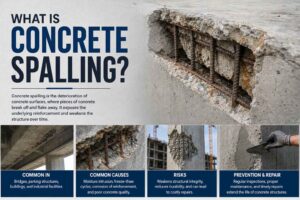
Think of concrete like a giant sponge. It looks solid, but it’s actually porous. Inside that concrete, there are steel reinforcement bars that provide the strength. When water, salt, or carbon dioxide seeps into the concrete, the steel rebar starts to rust.
And when steel rusts, it expands to about three to four times its original size. This internal pressure pushes against the concrete from the inside out until a chunk of concrete falls off.
That flaking, pitting, or breaking away is what we call spalling. If you’re in a coastal city, you might hear locals looking for concrete spalling repairs Sydney or Brisbane experts, simply because the salt air accelerates this rusting process like crazy.
Step 1: Damage Assessment (The “How Bad Is It?” Phase)
Before you jump into how to fix spalling concrete, you need to know what you’re dealing with. A quick visual DIY inspection is a good start, but for big structures, you might need a pro.
- The Tap Test: Take a hammer and gently tap the area around the crack. If it sounds “hollow” or “drummy,” the concrete has detached from the rebar inside. That’s a red flag.
- The Depth Check: Is it just a surface flake (aesthetic), or is the steel bar completely exposed? Exposed steel is a structural emergency.
- Visual Rust: If you see orange or reddish-brown tea-staining on the surface, the “cancer” has started.
Step 2: The Repair Process (Rolling Up the Sleeves)
If you’re wondering how to fix spalling, the process is actually a bit like dentistry. You have to remove the “decay” before you can fill the hole.
- Preparation: You can’t just slap new cement over the old stuff. You have to chip away the loose, damaged concrete until you reach “sound” (solid) concrete.
- Cleaning: It is the most important part. The rusted steel rebar needs to be scrubbed with a wire brush or sandblasted until the rust is gone.
- Treatment: Apply a zinc-rich cold-galvanising coating or an anti-corrosion primer to the steel. It acts as a shield against future moisture.
- Patching: Use a high-quality polymer-modified repair mortar. Unlike standard bag-mix cement, these are designed to bond to old concrete and shrink less as they dry.
- Sealing: Once the patch is dry, apply a waterproof sealer over the whole area to keep the water out for next time.
Also Read – How Non Destructive Digging Prevents Costly Underground Damage in Australia
Beyond the Walls: Bitumen and Infrastructure
Spalling isn’t just a “house” problem. It’s a massive issue for our national infrastructure. Think about the bridges, tunnels, and piers that keep Australia moving. Often, concrete repairs go hand-in-hand with bitumen repair.
On driveways or commercial lots, water can seep under the asphalt, causing the underlying concrete slab to spall and the bitumen to crack or pothole. Managing both ensures the entire surface stays level and safe.
This is where water infrastructure services come into play. These teams look at the big picture, how water moves across a site. If your concrete is spalling because of poor drainage, just fixing the crack won’t help; you have to fix the water flow.
The “Green” Future: Stormwater and Concrete Longevity
As we move toward more sustainable building practices in Australia, we’re seeing a rise in green stormwater infrastructure. Instead of letting rainwater pool on concrete surfaces (which leads to cracks and spalling), “green” designs use permeable pavements, rain gardens, and bioswales to divert water back into the ground.
By reducing the amount of time water sits on or against a concrete structure, we naturally extend the life of the building. It’s a win-win: less money spent on spalling concrete repairs and a healthier environment for our suburbs.
Why Local Expertise Matters
If you’re searching for spalling concrete repairs in Sydney, it’s because you know the humidity and salt are your biggest enemies. A repair that works in the dry heat of Alice Springs might fail in six months in a humid, coastal environment.
Professional infrastructure services understand the specific “exposure classifications” of Australian postcodes. They don’t just fill a crack; they engineer a solution that accounts for the thermal expansion of our 40°C summers and the corrosive breath of the Pacific Ocean.
Also Read: – Roadworks Case Studies by Civilcraft: Proven Infrastructure Solutions
Conclusion: Prevention is Cheaper than a Cure
Fixing concrete repair cracks as soon as they appear is the best way to avoid a five-figure repair bill later. Concrete spalling is a progressive disease; it doesn’t get better on its own. Keep your gutters clean, ensure your balcony drains aren’t blocked, and if you see a rust stain, act fast. Your house (and your bank account) will thank you before spalling concrete repairs.
FAQs
Q:- How much do spalling concrete repairs cost?
Ans:- It varies wildly! A small DIY patch might cost $100 in materials, but professional structural repairs for a balcony can range from $2,000 to $15,000, depending on the height and damage.
Q:- Can I just paint over the rust stains?
Ans:- No! Painting over rust is like putting a Band-Aid on a broken leg. The rust will continue to expand underneath the paint, and eventually, the whole chunk will fall off anyway.
Q:- Is concrete spalling covered by home insurance?
Ans:- Generally, no. Most Australian insurers view spalling as a “maintenance” or “wear and tear” issue rather than accidental damage. Check your PDS, but don’t count on it.
Q:- How long does a concrete repair last?
Ans:- A professional repair using the “cut and patch” method with anti-corrosion coatings can last 10–20 years, provided the underlying moisture issue is solved.
Q:- What’s the difference between a crack and spalling?
Ans:- The house settling or the concrete shrinking often causes concrete repair cracks. Spalling is when the surface actually breaks away due to the internal pressure of rusted steel.